Frank Schätzlein has a collection (in German) of on-line literature and resources about plagiarism:
Plagiate an der Schule/Universität
Literaturliste und Links
He includes a long list of paper mills both for German and English papers.
Wednesday, July 11, 2007
Saturday, July 7, 2007
Comic: Citation needed
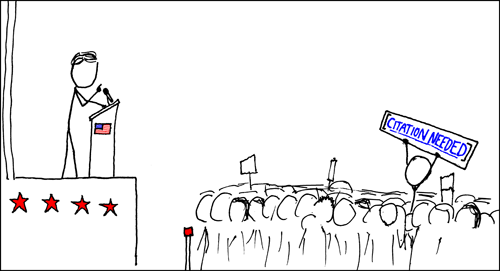 This is a rather techie in-joke, but actually very funny: it is from xkcd, which calls itself "A webcomic of romance, sarcasm, math, and language."
In the Wikipedia, more and more, exact citations are being demanded, so that the texts have more of a scientific basis. Sometimes the fight goes too far, with editors insisting on citations for things like water boiling at 100 degrees Celsius, it seems. But overall this is the way we need to go: move from a copy&paste culture to a citation culture.
Thanks to a blog reader from Germany for sending me this link!


Copyright Explained
An excellent blog entry: Copyright Explained - I May Copy it, Right? This is a great run-down of (US) copyright, chock-full of links!
More good links from this page:
More good links from this page:
Friday, June 29, 2007
Test of Plagiarism Detection Software
I am currently redoing my E-Learning-Unit on plagiarism, "Fremde Federn Finden" (in German). As part of the work I am repeating the test that I conducted on plagiarism detection software in 2004. Then I used 10 papers that I wrote myself with a known amount of plagiarism / originality to see how well the software measured up. It was not a pretty sight - often flipping a coin was just as effective.
For the repeat of the experiment I have 10 more papers and will be conducting tests over the summer of the following products from various countries:
The results will be published online in September 2007.
For the repeat of the experiment I have 10 more papers and will be conducting tests over the summer of the following products from various countries:
- CopyCatch Investigator - UK - http://www.copycatchgold.com/index.html
- Doc Cop - Australian - http://www.doccop.com/
- Docoloc - German - http://www.docoloc.de/
- Ephorus - Dutch - http://www.ephorus.nl/
- Eve2 - Unknown, no address given - http://www.canexus.com/
- MyDropBox/ SafeAssignment - English - http://www.mydropbox.com/
- Plagiarism Finder - German - http://www.plagiarism-finder.de
- StrikePlagiarism - Polish - http://strikeplagiarism.com/
- TextGuard - German - http://www.TextGuard.de
- turnitin - USA - http://turnitin.com/static/index.html (iThenticate seems to be the same software but targeted to businesses and not schools - http://www.ithenticate.com/static/home.html)
- Urkund - Swedish - http://www.urkund.com/
The results will be published online in September 2007.
Stolen from the Wikipedia
Many pupils and students think that the Wikipedia is there to let them hand in term papers very easily. The German Wikipedian Avatar has started a collection of stories about sad happenings to people getting caught in a plagiarism.
They include a student trying to cover his tracks by changing the Wikipedia article and some links to discovered plagiarisms by journalists and publishers of articles in the Wikipedia. There are some from both the English and the German WP, more are welcome.
They include a student trying to cover his tracks by changing the Wikipedia article and some links to discovered plagiarisms by journalists and publishers of articles in the Wikipedia. There are some from both the English and the German WP, more are welcome.
Thursday, June 7, 2007
Whistleblowing hurting your career
Janet Stemwedel's blog article "The price of calling out misconduct" about an article in Science describing the situation of some graduate students who blew the whistle on their advisor is very depressing.
Here we have courageous grad students working to better science by letting the community know that their advisor is making up data, and they end up paying the bill. Janet quotes a fascinating paper from Science and Engineering Ethics by C. K. Gunsalus's excellent paper "How to Blow the Whistle and Still Have a Career Afterwards." I think I will print out a copy for my administration, as the next article is on how to avoid whistleblowing problems in your institution.
Very important is finding both sides to an issue, as many people often misunderstand what is actually happening and start threatening lawsuits without being sure. On the other hand, if it really is misconduct, then you have to do something.
Here we have courageous grad students working to better science by letting the community know that their advisor is making up data, and they end up paying the bill. Janet quotes a fascinating paper from Science and Engineering Ethics by C. K. Gunsalus's excellent paper "How to Blow the Whistle and Still Have a Career Afterwards." I think I will print out a copy for my administration, as the next article is on how to avoid whistleblowing problems in your institution.
Very important is finding both sides to an issue, as many people often misunderstand what is actually happening and start threatening lawsuits without being sure. On the other hand, if it really is misconduct, then you have to do something.
Tuesday, June 5, 2007
Plagiarism increased four-fold in Sweden
Svenska Dagbladet reports that the number of reported plagiarisms at the University of Södertorn, near Stockholm, has increased four-fold during the last five years - and that with the total number of students decreasing.
They cite a report put out by the Hogskoleverket, the government university agency, which will be published next month. The report finds more plagiarism in term paper writing than in cheating on exams. Under the Swedish system, students who are caught cheating or plagiarizing are brought before a board, the disciplinnämnden, which decides if punishment should be meted out. Punishment is suspension from school for a period of up to 6 months - usually pronounced just before exam time, so that the deliquient cannot take some exams.
Taking exams in Sweden is vital - if you pass 75% of the credits of your first year at college, you can get funding for the next year, and so on. So there is quite an incentive to get those 75% credits.
The university uses a so-called plagiarism detection software for checking term papers, the article does not mention which one. Out of 15 400 submitted papers last year there were 36 suspensions meted out. 2003 there were only 10 suspensions pronounced. That is a quota of 0.23 % - and far, far below what teachers report when they hand-check term papers. There are reports accumulating pointing to figures more in the 10-30% range.
The report continues that 3 of the suspended students took the university to court - and won their suspension rescinded. That looks to me like an 8% false positive rate in the software. Perhaps they need to look hard at their software, or find other methods - like using search machines - for assessing this problem.
You can't solve social problems with software - and most certainly not with software that is this bad.
They cite a report put out by the Hogskoleverket, the government university agency, which will be published next month. The report finds more plagiarism in term paper writing than in cheating on exams. Under the Swedish system, students who are caught cheating or plagiarizing are brought before a board, the disciplinnämnden, which decides if punishment should be meted out. Punishment is suspension from school for a period of up to 6 months - usually pronounced just before exam time, so that the deliquient cannot take some exams.
Taking exams in Sweden is vital - if you pass 75% of the credits of your first year at college, you can get funding for the next year, and so on. So there is quite an incentive to get those 75% credits.
The university uses a so-called plagiarism detection software for checking term papers, the article does not mention which one. Out of 15 400 submitted papers last year there were 36 suspensions meted out. 2003 there were only 10 suspensions pronounced. That is a quota of 0.23 % - and far, far below what teachers report when they hand-check term papers. There are reports accumulating pointing to figures more in the 10-30% range.
The report continues that 3 of the suspended students took the university to court - and won their suspension rescinded. That looks to me like an 8% false positive rate in the software. Perhaps they need to look hard at their software, or find other methods - like using search machines - for assessing this problem.
You can't solve social problems with software - and most certainly not with software that is this bad.
Subscribe to:
Posts (Atom)


 Posts
Posts


