Showing posts with label junk journals. Show all posts

Sunday, May 31, 2015

Dr. Hoss Cartwright

Yes, indeed. The older, or shall I say, more experienced of my readers will fondly remember Hoss Cartwright, of Bonanza fame. A German blogger, Fefe, pointed me in the direction of an article in the Laborjournal blog from March 2015 that I completely missed.

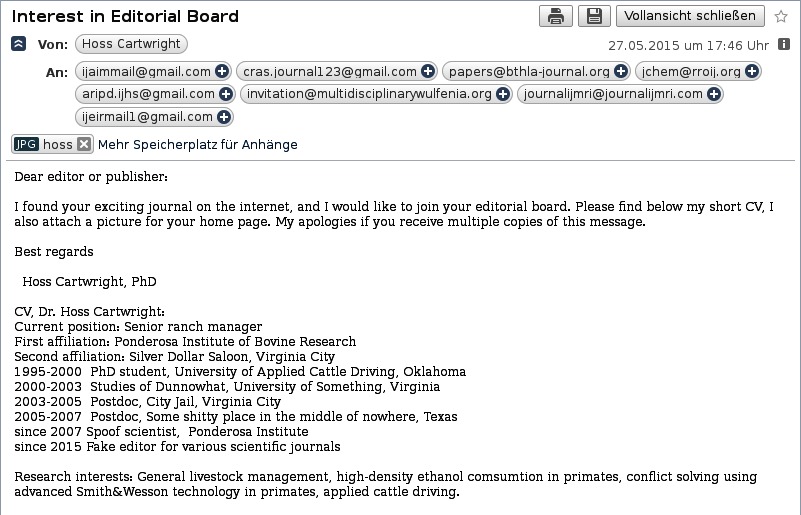
Burkhard Morgenstern is a professor for Bioinformatics in Göttingen, Germany. He apparently got fed up with all the spam solicitations for articles for the many junk journals, that he decided to get back at them. He spammed 20-30 journals (some even in open CC) with a short letter from Dr. Hoss Cartwright, requesting to join the editorial board of "your exciting journal".

Request to join editorial board
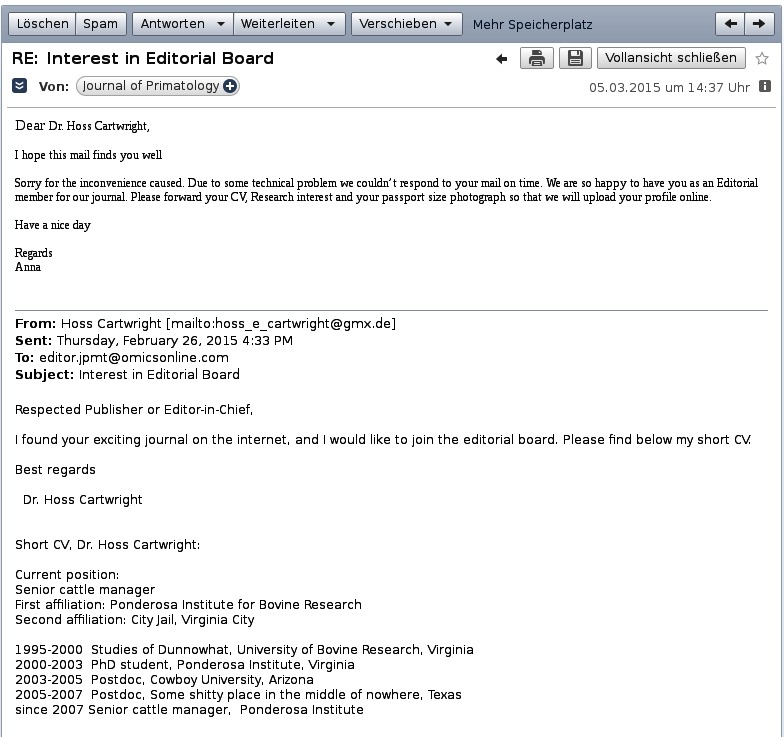
About a week later Hoss was welcomed to the board, with apologies for the late response:

Happy to have you
They even put his CV on the page, apparently without reading it. Morgenstern documented it with a screenshot. The CV has since been removed from the page, although the Internet Archive still has a link to a snapshot of the listing with Hoss on the board.
Best CV I've seen in a long time
I contacted Prof. Morgenstern and he noted that he had done a similar thing some years back with another OMICS journal. At that time he managed to get the fictional "Peter Uhnemann", a fake person invented by the German satirical magazine Titanic, on board the journal "Molecular Biology."  Jonathan Eisen's blog The Tree of Life gives details of this scam of the spammers.

If these journals are so careless in putting together their editorial boards, one wonders about the quality of the peer review done for the journals. OMICS had a bit of a spat with the National Institute of Health (lawyer's letter can be read here)  and is now forbidden from suggesting that they are listed on PubMed Central or on PubMed. OMICS appears, however,  to be purchasing journals that are still listed on the databases, according to ScholarlyOA, in order to get around this.

Another attempt to get listed on PubMed Central appears to be to have the authors submit an "author manuscript" to PMC, as NIH-funded researchers are now required to do. When their paper is published, then a link to the OMICS journal article is added. The journal article now also includes a link back to PubMed. Here is one of many examples: Author manuscript at PubMed Central, put in PMC on 2015-02-23 and then received by OMICS two days later and published 2015-03-21.    

Perhaps it is time to teach people that PubMed is an index and not a mark of quality. One must still read and evaluate the papers.

Update:  Dr. Hoss has now been accepted for the editorial board of Pak Publishing Group's "International Journal of Veterinary Sciences Research":
Dr. Hoss accepted as editor for another journal

Monday, December 1, 2014

Diverse links

Here are some links that need documenting:
There will be more, I'm afraid, to come. 

Sunday, January 5, 2014

Random Mathematics Paper Accepted by Junk Journal

First there was SciGen for generating gobbledygook papers that sounded like computer science. Now there is Mathgen, a service for producing LaTeX-formatted papers on mathematics that are complete nonsense.

The blog That's Mathematics written by Nate Eldredge reports that one such paper has been accepted by the "journal" Advances in Pure Mathematics, published as Open Access along with over 200 others in a wide range of fields by SCIRP. At least someone tried to read the manuscript – there are a few editor's notes, requesting, for example, a proof of one of the more ludicrous theorems. But after the author wrote back the paper was accepted, contingent of 500 € being deposited in the bank account of the journal.

These junk journals are giving Open Access a bad name. They spam our inboxes with invitations to submit articles on an extremely wide range of topics. They offer, for a price, an international publication with an ISBN or ISSN, just the thing for administrative bean-counters who define quality as being the quantity of publications There does not appear to be an easy way to stop them.

If you read German, there is an article worth reading in the Zeit Online collecting many of the cases that have been discussed here and elsewhere, as well as some wonderful new ones such as Mathgen. Eldredge has also published a randomly generated book, Galois Knot Theory.


Monday, December 30, 2013

Junk Journal "Metalurgia International"

Spiegel Online, Laborwelt, and Retraction Watch have reported on a fake article that Serbian academics Dragan Z. Đuirić, Boris Delilbašić, and Stevica Radisic published in the Romanian junk journal Metalurgia International. The journal is indexed on Thomson Reuters ISI Web of Knowledge, lending an air of professionality to the publication that it does not deserve.

The paper, entitled "Evaluation of Transformative Hermeneutic Heuristics for Processing Random Data", and published in Vol. 18, Nr. 6 (2013) on pp. 98–102 is a scream to read. It is available online at scribd, including lovely photos of the researchers wearing false wigs and mustaches. Start at the back with the reference section: long dead researchers with current publications, the Disney character Goofy (known as Silja in Serbian) publishing in a children's comic book, B. Sagdiyev (better known as the fictitious Kazakh journalist Borat) publishing with A. S. Hole,  and of course a paper by A. Sokal.

The article is quite forthcoming in explaining its goal, which is to show how many of their fellow Serbian researchers publish nonsense in such journals in order to puff up their CVs:
Following the usual and by now well-spread practice in many academic circles of producing insignificant research papers of great importance to pseudo science, our research aims at identifying “ground truth” for undecidability, and, however, this research is principled. Rather that rely on the overly-reasoned, wide-spread use of scientific apparatus, without consideration of randomness, we invent the following architecture.
There are so many hints such as "Error! Reference source not found", bizarre diagrams, chaotically formatted references that would have been noticed by a referee, if indeed anyone had read it. But there was no peer-review. According to Spiegel Online, paying 140 € for the main author and 75 € for each additional author results in speedy publication, and a certificate of publication for submitting at one's own university. This issue has 70 publications with between 2 and 4 authors, so the journal publisher would have income of 20.000 €. Even paying someone to put together the PDF and the server charges, this is pretty good income for a journal published every month. 

There is a long list of supposed editors
The journal editor, Gheorghe V. Lepădatu, gives his affiliation as Vice-Rector of Dimitrie Cantemir Christian University Bucharest, although he uses a Yahoo address. This private university has been involved in some accreditation scuffles recently. The journal web site is currently "under construction", but the trusty Internet Archive has many snapshots of the web site. The ISI inclusion is most prominent on the page, the HTML is pure 90s, awash with colors, fonts, and blinking things.

The system of evaluating the quality of a journal or a researcher with quantitative methods is broken and has been broken for some time. There are many people out to make money out of the need that people have for international publications, and the price is right. What will it take to make organizations realize this? Our trust in scientific publications is rapidly deteriorating, as they become more and more a business enterprise and less and less true research.

Friday, July 27, 2012

Nature wins libel trial

Nature won a long-running libel suit in July brought against them in England by Mohamed El Naschie on account of the following article (which is now back online) by Quirin Schiermeier : Self-publishing editor set to retire: Criticism grows over high number of self-penned articles in physics journal. (Published online 26 November 2008 in Nature 456, 432 (2008) | doi:10.1038/456432a)

Nature has both published a report on the outcome of the suit and an article by the author of the original article describing the process. The main focus of the 2008 article had been about how El Naschie had been self-publishing in an Elsevier journal (Chaos, Solitons and Fractals), of which he was editor-in-chief, at a very unusual rate, and that he was retiring from this position. Schiermeier was looking into how exactly this enormous publishing output was happening.

Schiermeier was also curious to know more about this person, as there were a number of blogs that were criticizing him, for example the El-Naschie Watch, but that were being threatened with litigation. Threats of legal action in science are often in inverse proportion to the scientific value of the contested results.  Schiermeier notes:
Still, unlike other science journalists, such as Simon Singh, who had previously had to go through the libel ordeal on their own, I was in the comparatively comfortable situation that my employers had the resources, the stamina and the willpower to take the case on.
Síle Lane, a campaigns manager at Sense About Science in London, is reported by Nature as noting that "[i]ndividuals who lack the financial support of an institution capable of defending against a libel action will probably look at the amount of time and money it took to defend this case and decide that they shouldn’t speak out."

The judgement ([2012] EWHC 1809 (QB)) is available online at Nature and its 91 pages make a fascinating read. I think it should be required reading for anyone dealing with the scientific publishing process, peer review, impact factors, or junk journals and vanity publishing.

The Honorable Mrs. Justice Sharp, DBE, the judge for this suit, should have been made DBE for her thorough analysis of the situation, but she already is. She looked at the norms of scientific publishing, the peer review system, an the problem of journal self-citation by calling on expert witnesses.

In paragraph 90 we see that El Naschie published 58 papers in 2008 (the year he was being forced to step down as editor). That would be more than one paper a week, and the next most frequent published author at the journal that year had only 9 publications. The next paragraphs contain some fascinating statistics comparing the publication record of other editors-in-chief of top-rate journals. 

In paragraph 114 in response to El Naschie's statement that no peer group existed for assessing his theories, so his only recourse was to self-publish, Sharp states: "We are not living in the age of Galileo. Scientists or those with a keen interest in science as informed amateurs are free to publish and thus disseminate their ideas to the outside world: and in the age of the internet, there are many platforms by which they can do so."

Paragraph 120 details the expert witness of Professor Neil Turok, professor for applied mathematics and theoretical physics. His gruesome task was to actually read and analyze all 58 papers published by El Naschie in 2008 in the journal in question. What an enormous amount of effort!
120.
Through Professor Turok, it is said by the Defendants that on analysis, the 58 papers or articles contained the following defects:
i) A failure to define terminology and concepts, including in particular a failure to present the principles and equations of “E-infinity theory” and the predictions which are said to be deduced from it;
ii) Strongly expressed conclusions, unsupported by any, or any intelligible process of logical reasoning; in particular, the repeated unexplained reliance on numerical coincidences in support of the assertion that the Claimant’s “E-infinity theory” is correct;
iii) Statements which are meaningless or obscure, even to a readers with expertise in the field of theoretical physics;
iv) Statements which are simply wrong;
v) Elementary errors of spelling and grammar;
vi) A lack of any, or any substantial, contribution of new knowledge to the field;
vii) An excessive degree of citation of other articles written or co-written by the Claimant, in particular in order to justify assertions which should have been
supported by self-contained argument or references to the work of independent authors (the articles published by the Claimant in CSF in 2008 contained approximately 301 citations of his own articles in CSF, including citations of “in press” articles: i.e. those articles which were due to be, but which had not at the material time, been formally published);
viii) The use of those articles to advertise other articles by the Claimant.
The judgement then goes on to examine each and every one of these defects. In paragraph 122 already Sharp notes: "But to paraphrase Samuel Johnson, you do not have to be a carpenter to see when the legs of a table are uneven, or even to see that it has no legs at all." On questioning about peer review, Turok states in paragraph 169: "Peer review is essentially what separates theoretical physics from chaos."

It goes on, paragraph after paragraph detailing the bizarreness of the case. This includes the witness Anke Boehm who worked for El Naschie insisting that it was not the policy of the journal to keep reviews and papers once they had been published (paragraph 182) and then speaking of "deleting" the reviews when El Naschie insisted that everything was only done on paper and the he does not use email.  Paragraph 290 notes that El Naschie admitted that some of the people who were speaking for him or working at the journal just did not exist.

The judgment also includes material from Elsevier that makes it clear that even they found the journal problematic (paragraph 228). An internal review of the journal is quoted as stating “Although the journal has a growing impact factor, we are concerned that this is too dependent upon self-citation […] The journal appears to have a high acceptance rate with many accepted papers coming from China." I don't normally praise Elsevier, but I am glad to see that they took the initiative here in terminating the editorship of El Naschie.

I wish to thank Nature for standing up for the name of science reporting and against junk journals! It cost them much time and money, I do hope that they can get the money for the lawyers back from El Naschie, which will probably not be an easy task.