Showing posts with label retraction. Show all posts

Monday, April 25, 2016

Seven more retractions for Danish computer scientist

Back in 2012, the German plagiarism documentation platform VroniPlag Wiki published a documentation about extensive plagiarism in a computer science dissertation submitted in 2007 to the Danish University of Aalborg at Esbjerg. This sparked some media attention (and was reported in this blog in May 2012) and eventually an investigation of the Danish national academic integrity body UVVU (Danish Committees on Scientific Dishonesty) was initiated. That body ruled on December 2, 2014: (English translation)
The Committee finds that the Defendant has acted in a scientifically dishonest
manner in the form of plagiarism [...]
I managed to obtain many of the documents produced by means of a freedom of information act inquiry. The UVVU mounted an exhaustive inquiry, and also informed the university currently employing the author as a professor of their decision. Interestingly, he is still listed at the university as of today, and has current publications listed.

The thesis borrowed heavily from journal articles and conference papers published either alone or in collaboration with others that turned out to include much text overlap with publications of other researchers. And after the thesis was defended, many more papers were published, again with others, that again contained extensive text overlap both with papers by other authors and with text from the dissertation. The true sources were about identifying criminal networks, the copied papers were on the topic of identifying terrorist networks.
The source is on the right, the edited copy on the left
VroniPlag Wiki lists more than 20 papers to date that are affected by substantial text similarities. The publisher at Springer and IEEE were informed, and this blog discussed some of the papers in June 2012.  In January 2013 eight papers were retracted by the IEEE.

Springer published 10 of these papers, but was quite indecisive as to how to deal with the situation. In a journal, a retraction can be published in the next available issue. However for conference proceedings, there is often no "next" volume in which to note the retraction. Of course, since the papers are all online, they can at least be retracted there. In January 2014 I found that Springer had published a retraction of one of the papers, but then retracted the retraction just a few days later, publishing an erratum instead.

During an idle search in April 2016, one of the VroniPlag Wiki researchers was surprised to see that Springer had quietly retracted seven of the ten papers. Of course, Springer wants the general public to invest $ 30 to read the retractions:

I was able to obtain four of the seven retractions because they were published in proceedings that my library has access to. The notices read as follows:
The publisher regrets to announce that the following chapter entitled [...] has been retracted. This chapter contains a large amount of reused and uncited material that was not published within quotation marks.
Looks to me as if Springer has come up with a new euphemism for that nasty P-word.

I find it troubling that Springer needed so many years to act on the information given to them about the problematic publications. And even though Springer is a member of the Committee on Publication Ethics (COPE),  they did not follow the advice given in the COPE flowcharts for dealing with such situations. This includes as a final step "inform the person who originally raised the concern."

Saturday, October 10, 2015

Just a notice

An interesting kind of retraction was recently brought to my attention. It seems that a professor of law had published an article in the bi-weekly Juristenzeitung on, of all things, copyright and academia. As the Passauer Neue Presse reports and the Legal Tribune online comments, this article about Open Access reproduced some passages from another legal scholar without attribution, and the university is investigating.

Sharp eyes found an intriguing entry on page 936 of the current issue of Juristenzeitung: For only $ 33 plus tax (unless your institution subscribes) you can download a copy of this short notice (translation mine, names left out to keep me from being sued):


Notice about the article "'Ein Knauf als Tür' ...." by U..... M.....:

This contribution contains verbatim material on pages 222-225 of the main text as well as in the footnotes on pages 223, 224, 226, 227, 231, and 232 that was taken from the article by A.... P. .... I regret deeply, that this presumption of copyright happened and accept the full responsibility for it. I would like make a formal apology to A... P...

U..... M......

(Editor's note: We were informed of the problem by the author and wish to join in the apology. The electronic version of the article is no longer online.)
Hmm, this is a de-publication at the publisher's site instead of publishing a retraction notice. The online table of contents jumps from page 221 to page 232, the article has vanished. Of course, the abstract is still on the Juris database and at Researchgate and probably a number of other places. Do lawyers not understand that an article, once published, is now publicly available, and thus should not just disappear, but a notice of what happened put in its place? It could even have been quoted, and of course still may be, as it is in the print issues.

Isn't there something also missing in the "notice"? An apology to the readers? Because they, much more so than the original writer of the text, are the ones who were misled. A documentation and discussion of the extent of the "verbatim material" can be found in the depths of the Internet.

Saturday, July 25, 2015

End of Semester Roundup

Here are some links about plagiarism and academic misconduct from around the world that have been languishing in my inbox:
  • A professor for African-American History at the Arizona State University in the US has been demoted from full professor to associate professor, according to the Phoenix New Times, after a second plagiarism scandal about his writing erupted. A  blog contains many more details about the plagiarism allegations. Retractionwatch also has an article about this case. The professor is said to have used, among others, sources many students find useful: Wikipedia.
  • Writing in a blog at the Daily Pakistan Asif A. Malik points out a wonderful piece by physics professor Pervez Hoodbhoy from the Express Tribune from January 4, 2013. Hoodbhoy starts off with a thought experiment: "Imagine the following experiment aimed at improving Karachi’s police force: suppose that policemen are offered cash prizes for every criminal they kill in a police muqabala, given public recognition and told that promotions to higher posts hinge on their kill count." He spins the story out that, of course, the police would start shooting at anyone, just to increase their pay. That is, in essence, what is happening in academia, except that instead of a "kill count" there are the magic indicators "number of publications" and "citation index". Since 2002-2003 both the pay and promotion for professors in Pakistan depend on the number of papers published and the number of PhD and MSc students graduated. Surprise! These all increased!
    In 2012 Hoodbhoy wrote about the problem of telling the good from the bad, in the Express Tribune column in 2013 he noted that the apparent increase in quality proudly proclaimed by the Higher Education Council (HEC) "was only possible because many university teachers engaged in wholesale plagiarism, faked data and produced research that no one seems to have any use for. As academic ethics went into free fall, university administrators and the HEC turned a blind eye. The new policy — which required learning how to play the numbers game — had the effect of turning many professors into crooks and thieves."
  • The Times of India writes that a professor from the Postgraduate Institute of Medical Education & Research in Chandigarh has been found to have plagiarized from two US American sources. Rakesh Sehgal retracted a paper from the journal Tropical Parasitology, published by Wolters Kluwer Medknow. The retraction notice states only that the paper has been retracted, not why. In a previous article, the Times of India noted that according to Indian law, a jail sentence between 6 months and 3 years can be levied, and public servants can lose their jobs if found to have plagiarized. 
  • Richard de Boer published an atricle in the Dutch newspaper de Volkskrant on July 4, 2015 called "Welkom in de wereld van nepwetenschap" (welcome to the world of junk science), but the article is unfortunately behind a paywall and in Dutch. I was able to obtain it and use Google translate. The article deals with mock conferences like WASET and junk journals like those published with the OMICS group, which was removed from the PubMed list in 2013. There are a number of interviews with people attending the conferences, positive and negative, and also with a former colleague of the WASET organizer. The article discusses both Jeffery Beall's publisher black list and the Directory of Open Access Journals white list, noting problems with each. What a shame such an in-depth article is unavailable to a wider audience.
  • Hatoon Kadi writes in her blog at Arab News the Memoirs of a Saudi Ph.D. student: The menace of plagiarism. She mis-believes, as many do, that "[t]here are certain programs that take a few seconds in determining the originality of any research material." No, software can only detect potential text overlap, it cannot determine plagiarism or originality, because all systems suffer from false positives (quotation not seen) and false negatives (source not stored in the database). She discusses the question of hiring a ghostwriter with friends and found to her dismay that many had no qualms about using work from others. She calls for strict laws to punish plagiarists. I don't think punishment works -- we need to educate people as to why referencing and quotation is important.
Now, back to grading exams.

Saturday, December 20, 2014

Christmas Links

I seem to be getting more and more links I can't adequately deal with, but which I don't want to withhold from readers. So here is some Christmas reading:
  • The "Neurosceptic" blog of Discover Magazine has a piece about The Strange Case of “Publication Integrity and Ethics” which details a number of integrity and ethics questions around the supposed new journal.
  • The Times Higher Education has a piece on post-publication peer-review that describes more of the chilling consequences that occur when lawyers meddle with scientific inquiry. Physics professor Philip Moriarty is quoted with: “If you are publicly funded and you put your research into the public domain but no one can criticise you for it without facing legal proceedings, that seems to me to be a very badly damaged system.” Exactly.
  • Retraction Watch obtained a $400.000 grant to set up a retractions database! This is great news, I hope that the database can be used to calculate a Retraction Index, that is, how many retractions per article published a journal has, and perhaps how long did it take for the retractions to take place after the initial information of the journal.
  • Bernd Kramer recently published a book in German about obtaining a doctorate in Germany without doing the work ("Der schnellste Weg zum Doktortitel. Warum selbst recherchieren, warum selbst schreiben, wenn's auch anders geht?"). The cover is a horrible stock photo, but the book makes quite interesting reading. Kramer gave an interview in Deutschlandradio in November 2014 about it.
  • Reports of fake peer reviews are increasing. Vox has an article about 110 papers retracted in the past two years on account of faking peer reviews. Retraction Watch reported on SAGE publishers retracting 60 papers from just one journal for this reason. The Minister of Education in Taiwan, Wei-ling Chiang, had been added to some of these papers as a co-author (he says without his knowledge). He stepped down because of the scandal in July 2014, according to IEEE Spectrum
  • Taipeh Times reported in August of 2013 that Andrew Yang, the former Taiwanese Minister of National Defense was forced to resign in a plagiarism scandal a few days after taking office. He had published a book in 2007 that friends had ghostwritten for him. They had, however, plagiarized large parts of the book.
  • The University of Nevada in Las Vegas fired an English professor for "serial plagiarism." The student newspaper, The Rebel Yell, also reports on the case.
  • End of November 2014 the Vice Chancellor of Delhi University in India was jailed and released on account of plagiarism.
  • There is a nasty case of plagiarism reported from early 2014 at the Chicago State University. The dissertation of the Senior Vice President and Provost of the university was being investigated, and the university confirmed to press that they were doing so. She sued the university for violating privacy laws, stating that she did not plagiarize [1]. There exist documentations of plagiarism in her dissertation in a blog ([2] - [3] - [4] - [5] - [6]). Despite the documentation, the University of Illinois, Chicago has ruled that her dissertation is not a plagiarism ([7]). The Chicago Tribune had three plagiarism experts (Tricia Bertram Gallant, Teddi Fishman, and Daniel Wueste look at the thesis ([8]). All three find the thesis problematic. The question is, are the students to be held to a different standard than the person who is enforcing that academic standard? A thorny question.

Tuesday, January 14, 2014

Just an Erratum?

At the beginning of the month I reported on the retraction of a paper by N. Memon by the Springer Verlag. Retraction Watch then learned that Springer had retracted the retraction, making it into an Erratum instead:

Hmm, can a scientist publish a paper and a publisher sell it when a table has been copied without permission? Most particularly, why was the retraction retracted when Springer had already been informed over a year ago that this paper was a plagiarism? It reproduced material that the authors had also published with IEEE and which has been deemed a serious level 1 plagiarism there with the paper being retracted in January 2013 for being a greater than 50% plagiarism of prior work.

VroniPlag Wiki researchers applied the fragmentation technique to the paper in order to visualize the plagiarism (PDF) in a perhaps more understandable manner.

The colours show the type of plagiarism diagnosed:
  • grau=Komplettplagiat: the source of the text parallel is not given, the copy is verbatim.
  • rot=Verschleierung: the source of the text parallel is not given, the copied text will be somewhat modified.
  • gelb=Bauernopfer: the source of the text parallel is mentioned, but the extent and/or closeness of the copying is not made clear by the reference. 
The modified bits in red are a fascinating read:

"Joe talks to Jack" in the source becomes "Atta talks with Khalid" to give the text a better terrorist feel:
Original Katz et al. (2004) Copy


A paper about criminals gets reworded to address terrorists in the introduction:
Xu & Chen (2003) Copy


Why would a scientific publisher (and not a junk journal or other shady operation) not swiftly remove such a paper from their online offerings once they learn of it? They seem to be condoning it by playing down the seriousness of the offense, just speaking of an erratum and only focusing on the table. Do scientific standards and aspects of quality not count for anything these days?

Update: Link added, type 1 -> level 1, attempt to fix the formatting. Thanks to G. Hindemith!

Friday, January 3, 2014

Springer Finally Retracts Conference Paper

As reported here, VroniPlag Wiki determined in the course of investigating the doctoral thesis of Nasrullah Memon, awarded by the Aalborg University in Denmark in 2007, that very many papers in which he was co-author were also plagiarized. Denmark is still deciding what to do with the thesis, the last time I wrote to the authorities (August 2013) they were still deliberating, although I have heard that one of the co-authors of many of the papers has been cleared of charges of scientific misconduct. This I do not understand. If you are a co-author and the paper is plagiarized, you are a plagiarist as well in my opinion, or else you just put your name on a paper you didn't write, which is just as bad.

IEEE finally retracted some of the papers in January 2013, while Springer continued to sell the plagiarized papers for a hefty fee. Both the researcher at VroniPlag Wiki and I have written to Springer asking what is happening here. It seems they were unsure what to do in this case, although IEEE does have a policy that might be able to be adapted.

While surfing over Christmas the VroniPlag Wiki researcher stumbled over this:
Retracted: How Investigative Data Mining Can Help Intelligence Agencies to Discover Dependence of Nodes in Terrorist Networks
Nasrullah Memon,
David L. Hicks,
Henrik Legind Larsen
Okay, progress is being made! We wanted to look at the retraction notice, as most journals do give some sort of an explanation of why the article was retracted. RetractionWatch even collects wordy euphemisms for "plagiarism". But Springer wanted $30 from us to see the retracted paper. Hmm. Not even my university database would let me see the retracted paper for free, and we used to subscribe to exactly this series online.

If you click on "Look inside" you get to see the first page:
Well, I guess a watermark is a start. But it is still listed in the ACM Digital Library, ResearchGate, Google Books (only the first page, p. 430, was removed there), dplp, etc.
It has also been quoted 17 times, according to Google Scholar, 6 of which are papers for which Memon is not co-author, although some have published in the past together with him.

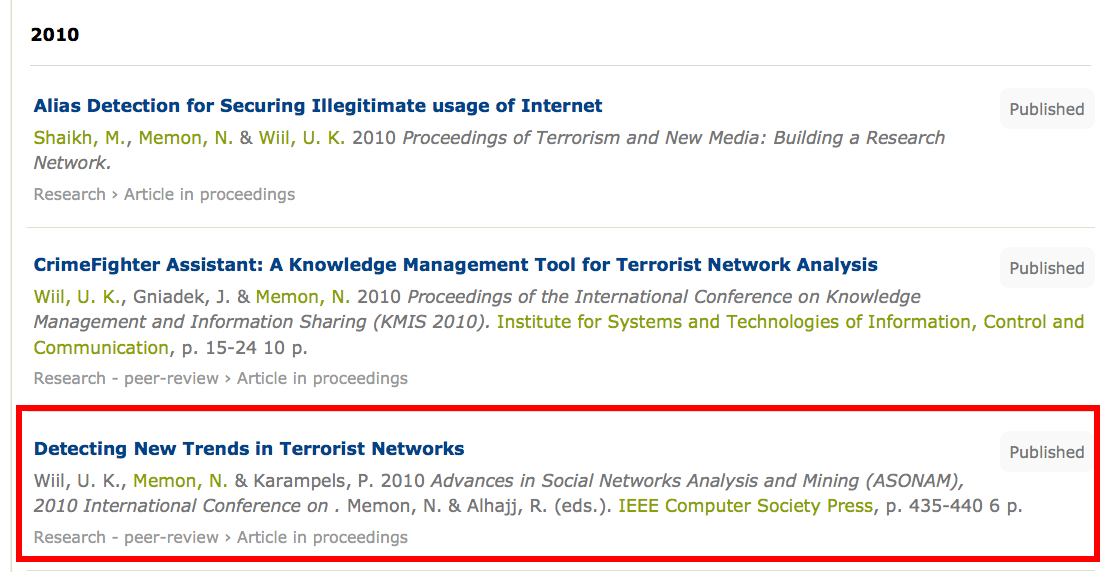
Memons's official publication list at the University of Southern Denmark only has the "newest" publications (including one for 2014 already), so many of the retracted ones have disappeared. But one of the IEEE retracted ones is still listed there:

It's bad enough that the publishers who earn good money for these publications are dragging their feet in deciding what to do. But how do we get retracted papers out of the body of science? That's the big problem and one of the reasons why plagiarism is so bad.

Suggestion to Springer: Please get going on the other papers, five of which are quite substantial, and print the reason for the retraction(s), free of charge.


Saturday, September 14, 2013

German University Revokes venia legendi

The WHU - Otto Beisheim School of Management in Vallendar is reported to have decided to revoke the venia legendi, the right to teach that is conferred with a habilitation, of Ulrich Lichtenthaler, according to the Rhein-Zeitung. He was a young shooting-star who received both a doctorate and the venia legendi from the WHU after studying in Bamberg and Grenada, according to his Wikipedia entry. At 30, the Rhein-Zeitung reports, Lichtenthaler was made professor and since 2011 he has been a professor at the University of Mannheim.

In 2012 Strategic Organization retracted a paper by Lichtenthaler and Ernst at the author's request. In a comment on the StrategicProfs.net blog an editor notes that Lichtenthaler contacted the journal proactively and claims responsibility for the statistical errors. Retraction Watch picked up the story, noting that two more papers in Research Policy by Lichtenthaler had also been retracted. Research Policy gives a very detailed reason for the retraction: not only were there statistical problems, but the journal was also misled in that "the author failed to disclose (through specific citations, or through a mention in the 'acknowledgements' section, or in a covering letter to the Editor)  the existence of other closely related papers by the same author." The journal Research Policy has published a paper on the role of retractions in the scientific community and more recently one by editor Ben Martin on the problems of plagiarism, self-plagiarism and coercive citation in research assessment. Both WHU and the University of Mannheim began investigations into Lichtenthaler's research, Retraction Watch notes.

Retraction Watch continued keeping score:
  • One month later, Strategic Management Journal retracted another paper. 
  • Retraction five was documented a week later, from Journal of World Business.
  • Three days later, retraction six from the Journal of Management Studies is found, it was first reported by the OpenInnovation blog.  
  • Holger Ernst, the doctoral and habilitation advisor and frequent co-author of the now-retracted papers, was removed as second author from a paper on Journal of Product Innovation Management.
  • In November 2012, Organization Science reported on retraction seven.
  • A few days later, Retraction Watch found retraction eight on the Journal of Business Venturing. That journal notes a familiar pattern: statistical irregularities and multiple publication.
  • Number nine was from the journal Technological Forecasting and Social Change. OpenInnovation  noted that they had previously thought this paper to be ripe for retraction.
  • The Journal of Product Innovation Management now retracted #10 and #11.
  • The twelfth retraction was noted in May 2013, from the journal Industrial and Corporate Change.
A press release by the WHU on Sept. 13, 2013 states that the investigation has now been completed and the habilitation rescinded. The press release notes that the decision to revoke the venia legendi was taken unanimously.

The University of Mannheim is on record from July 31, 2013, stating that they can't really say anything on account of data privacy, but that their own investigation is continuing.

This is an interesting dilemma currently confronting German universities. Although publications are openly seen to be plagiarized, published multiple times, withdrawn - the university treats the case as if it was an internal, disciplinary matter. Of course, they are afraid of lawsuits in the increasingly litigious German society. But still: academic matters are published matters, and the discussions about them should be public and not under the threat of lawsuits. It will be interesting to see what the university decides, as a venia legendi is still generally a requirement for obtaining a university professorship in Germany.

Wednesday, July 24, 2013

Retractions as references

A reader pointed out an interesting article to me that was published in October 2012 on PLoS:
Investigation of CD28 Gene Polymorphisms in Patients with Sporadic Breast Cancer in a Chinese Han Population in Northeast China by
Shuang Chen equal contributor, Qing Zhang equal contributor, Liming Shen, Yanhong Liu, Fengyan Xu, Dalin Li, Zhenkun Fu, Weiguang Yuan, Da Pang, Dianjun Li
Down in the article there is a statement that is referenced like this:
Compared with rs35593994 ‘G’, rs35593994 ‘A’ may promote transcription of the CD28 gene by the presence of a binding site available for the CCAAT enhancer-binding protein, but not GFI1 (which functions as a transcriptional repressor) [36]. 
Okay, I don't understand a word of this, but I can follow the reference:
36. Rathinam C, Klein C (2012) Retraction: transcriptional repressor gfi1 integrates cytokine-receptor signals controlling B-cell differentiation. PLoS One 7.
Retraction? Are they citing the retraction of the article as a reference for what had been stated in the article retracted? The retraction notice from July 2012 is pretty clear:
The authors wish to retract the article "Transcriptional repressor Gfi1 integrates cytokine-receptor signals controlling B-cell differentiation" by Chozhavendan Rathinam and Christoph Klein. PLoS ONE 2007, 2(3):e306.

After publication of the article, concerns were raised regarding the control bands in Figure 5A, and in particular, whether the bands represent total STAT5. Examination of the original Western blot data revealed that primary Western blot documents were not archived with due diligence. As a consequence, the doubts about the proper representation of the control bands in Figure 5A could not be unambiguously resolved. This course of action is in line with the recommendation issued by Hannover Medical School.
Retraction Watch noted in September 2012 that this was the second retraction for these authors, who often publish together. The retracted paper is listed on a CV of Rathinam's (that may, however, be automatically gathered from the web), but the retraction notice is not there. Klein has neither the retracted paper nor the retraction listed on his CV.

The question asked by my correspondent is: Does anyone actually READ the papers that are submitted to PLoS? It is supposedly a peer-reviewed online journal. Or is there a reason for quoting the retraction notice in this manner that escapes me?
 

Tuesday, January 15, 2013

Multiple Retractions of Articles by Computer Science Professor

VroniPlag Wiki case #23 was the dissertation in computer science of Nasrullah Memon, who is currently a professor at the University of South Denmark. The dissertation was submitted to the Danish University of Aalborg in 2007. VroniPlag Wiki documented extensive plagiarism not only in the dissertation (64 % of the pages), but also in many publications involving Memon. The publishers IEEE and Springer were informed of the problems.

IEEE has now retracted eight papers involving Memon, seven of them on the basis of the VroniPlag Wiki documentation:
  1. "Detecting New Trends in Terrorist Networks," by Uffe Kock Wiil, Nasrullah Memon, and Panagiotis Karampelas in the Proceedings of the 2010 International Conference on Advances in Social Networks Analysis and Mining (ASONAM), August 2010, pp. 435-440 is a plagiarism of "Social Network Analysis and Information Fusion for AntiTerrorism" by Pontus Svenson, Per Svensson, and Hugo Tullberg in the Proceedings of the 2006 Conference on Civil and Military Readiness (CIMI), May 2006 and Data Mining: Concepts and Techniques (second edition),
    by Jiawei Han and Micheline Kamber, Morgan Kaufmann, Elsevier, 2006. The lead author, Nasrullah Memon, was found to be solely responsible for the violation.
  2. "Detecting High-Value Individuals in Covert Networks: 7/7 London Bombing Case Study," by Nasrullah Memon, N. Harkiolakis, and David L. Hicks in the Proceedings of the IEEE/ACS International Conference on Computer Systems and Applications, 2008, pp. 206-215.
  3. "Detecting Key Players in 11-M Terrorist Network: A Case Study," by Nasrullah Memon and David L. Hicks in the Proceedings of the Third International Conference on Availability, Reliability and Security, 2008, pp. 1254-1259.
  4. "Practical Algorithms and Mathematical Models for Destabilizing Terrorist Networks," by Nasrullah Memon, David L. Hicks, Dil Muhammad Akbar Hussain, and Hendrik Legind Larsen, in Military Communications Conference, MILCOM 2007  is a plagiarism of "Untangling Criminal Networks: A Case Study" by Jennifer Xu, Hsinchun Chen in Proceedings of the First NSF/NIJ Symposium Intelligence and Security Informatics, ISI, June 2003 and "The Exploratory Construction of Database Views"  by M. N. Smith, P. J. H. King, Research Report BBKCS, School of Computer Science and Information Systems, Birbeck College, University of London, 2002. The lead author, Nasrullah Memon, was found to be solely responsible for the violation.
  5. "Harvesting Terrorists Information from Web," by Nasrullah Memon, David L. Hicks, and Hendrik Legind Larsen, in the Proceedings of the 11th International Conference Information Visualization (IV'07), 2007, pp. 664 - 671 
  6. "Detecting Critical Regions in Covert Networks: A Case Study of 9/11 Terrorists Network," Nasrullah Memon, K. C. Kristoffersen, David L. Hicks, and Hendrik Legind Larsen, in the Proceedings of the Second International Conference on  Availability, Reliability and Security, (ARES 2007), 2007, pp. 861-870 is a plagiarism of "Clique Relaxations in Social Network Analysis: The Maximum k-plex Problem" by B. Balasundaram, S. Butenko, I. V. Hicks, S. Sachdeva
    Posted online, January 2006 and "Network Analysis of Knowledge Construction in Asynchronous Learning Networks" by Aviv, Reuven; Erlich, Zippy; Ravid, Gilad; Geva, Aviva in the Journal of Asynchronous Learning Networks, Vol 7, No 3, 2003
  7. "Practical Approaches for Analysis, Visualization and Destabilizing Terrorist Networks," by Nasrullah Memon and Hendrik Legind Larsen in the Proceedings of the First International Conference on Availability, Reliability and Security (ARES’06), 2006, pp. 8xx - 913 is a plagiarism of the same sources as number 4.
  8. "Novel Algorithms for Subgroup Detection in Terrorist Networks," by Nasrullah Memon, A. R. Qureshi,  Uffe Kock Wiil,  and David L. Hicks in the Proceedings of the International Conference on Availability, Reliability and Security (ARES '09), 2009,  pp. 572-577 is a plagiarism of "Balancing Systematic and Flexible Exploration of Social Networks" by Adam Perer, Ben Shneiderman in the IEEE Transactions on Visualization and Computer Graphics, Vol. 12, No. 5 Sept/Oct 2006, pp. 693-700 and "Mining for Offender Group Detection and Story of a Police Operation" by Fatih Ozgul, Julian Bondy, Hakan Aksoy in the Proceedings of the Sixth Australasian Data Mining Conference (AusDM 2007), Gold Coast, Australia. Conferences in Research and Practice in Information Technology (CRPIT), Vol. 70, December 2007, pp. 185-189 and Smith and King from number 4 above.
Searching the IEEE database there are, however, 133 papers by Memon, and of course many more involving the co-authors, some of whom are prestigious Danish professors. The VroniPlag Wiki documentation also lists papers published by Springer, as well as dubious conferences and/or publishers such as WSEAS, Inderscience, or Worldcomp. Springer says that they are still investigating.

When interviewed by the Danish weekly newspaper Weekendavisen in May 2012, Memon had insinuated that dark powers had manipulated his thesis in order to discredit him. However in the face of the documented plagiarism in many other papers, it seems that a more detailed investigation into his publications needs to be mounted. The problem is, who will take action? Who has the time? It took over six months for IEEE to withdraw the publications after the plagiarism was clearly documented on VroniPlag Wiki. At least IEEE has a procedure for dealing with allegations, but it seems to take far too long, in particular because these papers have been cited, and not only in self-citations.

When will the University of Aalborg take action? Hicks, Wiil, and Larson are professors there. Hendrik Legind Larsen and Hsinchun Chen (the author of a work that was plagiarized in number 4) were members of Memon's doctoral thesis committee.When will the University of South Denmark look into the situation? Memon is advising doctoral students there, organized a conference on counterterrorism in Odense, and is a journal editor. Do the retractions have any consequences at his university?

According the the IEEE policy on good scientific practice,  a level 1 violation means that > 50 % of the paper is plagiarized, resulting in a retraction notice being printed and the authors banned for 3-5 years from publishing in any IEEE publication. It seems that more than one of the papers retracted are level 1 violations. Will the publication ban be consecutive? That is, if there are 3 level 1 violations, will Memon be banned from publishing for 15 years?

I am glad that IEEE has finally taken action (and there are over 500 notices of retraction in the IEEE database). But there are so many questions raised that I fear will not be answered.

Saturday, August 11, 2012

Inquiry results published

The Ludwigshafener hospital has published a press release about the results of the inquiry into the research of Joachim Boldt. He was the former "retraction king", having had to retract 88 of his publications. He has since been "de-throned" by Yoshitaka Fujii (as reported by Retraction Watch).

Boldt already left the hospital in November of 2010, after criticism of his research grew too loud to ignore. The board examining his papers needed a good 18 months to go through everything and determine that "in a large number of the studies investigated, the conduct of research failed to meet required standards. False data were published in at least 10 of the 91 articles examined, including, for instance, data on patient numbers/ study groups as well as data on the timing of measurements."

They try and play it down as being mostly a procedural thing, and are relieved that no patients came to harm. They promise that they have fixed procedures.

But I still have a few questions:
  • Where did the money for this research come from? Was this government money? Was it from a pharmaceutical company?
  • Has anyone used the since-withdrawn studies? That is, did anyone else quote his papers or try and replicate the experiments?
  • Is Boldt still permitted to practice medicine?
  • The hospital states that they will be monitoring future clinical studies - how will they be encouraging people to speak up about falsification of data? That has nothing to do with monitoring, which brings up notions of even MORE paperwork. How are they going to foster an environment in which people can question the research being done without fear of retaliation.
  • Why did this take 18 months?

Tuesday, July 17, 2012

German Professor retracts two papers from Research Policy

I have been alerted to the following two retractions at Research Policy:
Retraction Watch has the report that the author has voluntarily retracted a third paper:
  • Ulrich Lichtenthaler and Holger Ernst, Technology licensing strategies: the interaction of process and content characteristics, Strategic Organization,  Vol 7(2): 183–221, DOI: 10.1177/1476127009102672
Retraction Watch also gives a link to a Handelsblatt biography of Lichtenthaler (in German). Lichtenthaler is currently a professor at the University of Mannheim. The question arises as to whether these papers were instrumental in his obtaining the professorship, and how the university needs to react in the face of the retractions.

One paper was retracted because it was apparently a multiple publication (self-plagiarism), the others for statistical issues. Germany has no national policy on retractions, and even though some universities have ethical codices, there is often no clear road to follow when something like this comes up. With the amount of ethical problems being uncovered in Germany recently, one would think that there would be a national committee investigating. If there is, I am unaware of it.

Update August 16, 2012:  Retractionwatch has documented a fourth retraction by Lichtenthaler, this time from Strategic Management Journal.

Saturday, July 7, 2012

New Fake Data Record Holder

A reader alerted me to the new fake data record holder from Japan, displacing the current German record holder, Joachim Boldt, with only 88 retractions to his name, according to Retraction Watch. Both Retraction Watch and ars technica report on the Japanese anesthesiologist Dr. Yoshitaka Fujii from the medical school of Toho University. Fujii has published 212 papers, but the data to back up the papers can only be found for 3. Currently, 172 papers have been found to contain fabricated data. He also apparently forged signatures of supposed co-authors.

J. B. Carlisle published a statistical paper in Anesthesia in May 2012 ( DOI: 10.1111/j.1365-2044.2012.07128.x) entitled "The analysis of 168 randomised controlled trials to test data integrity":
"The published distributions of 28/33 variables (85%) were inconsistent with the expected distributions, such that the likelihood of their occurring ranged from 1 in 25 to less than 1 in 1 000 000 000 000 000 000 000 000 000 000 000 (1 in 1033), equivalent to p values of 0.04 to < 1 × 10⁻³³, respectively."
Highly unlikely, that. The university then started an investigation into this research, which was published in over 20 journals. They have just published their report. A comment on Retraction Watch hits the nail on the head: "Anesthesiologists need to WAKE UP to fraud".

Sunday, April 29, 2012

VroniPlag Case 23 had to withdraw IEEE Paper

An interesting find in the extensive IEEE database of retracted papers (Search Google for "Notice of Violation of IEEE Publication Principles" site:ieee.org, there are more than 24.000 entries) on VroniPlag case 23: A paper on the topic of the dissertation, published by the author after the dissertation, that had to be retracted on account of plagiarism:
Notice of Violation of IEEE Publication Principles (link)
"Novel Algorithms for Subgroup Detection in Terrorist Networks" by Nasrullah Memon, Abdul Rasool Qureshi, Uffe Kock Wiil, and David L. Hicks in the Proceedings of the 2009 International Conference on Availability, Reliability and Security, March 2009, pp. 572-577 
After careful and considered review of the content and authorship of this paper by a duly constituted expert committee, this paper has been found to be in violation of IEEE's Publication Principles. This paper contains significant portions of original text from the papers cited below. 
The original text was copied with insufficient attribution (including appropriate references to the original author(s) and/or paper titles) and without permission. (more).
I think the entire publication history of these authors needs to be looked at a little bit more closely. Especially since Memon, Hicks and Wiil all still list the withdrawn publication on their publication lists, and they seem to publish a lot together. Only Qureshi doesn't have the paper listed.

I informed the rector of the Aalborg university about the VroniPlag case on April 20. I still have not had any indication that my email was received, so I suppose I shall have to write again.