- The Bundesverwaltungsgericht, the Federal Administrative Court in Germany handed down an important decision in connection with the plagiarism case of former defense minister Karl-Theodor zu Guttenberg. The German parliamentary academic service had written documents for him that turned up in his dissertation, verbatim. A journalist filed a freedom of information order to obtain the documents, but the Bundestag refused. Of course, a copy of the documents had already turned up in a brown paper envelope addressed to one of the GuttenPlag Wiki researchers, bearing no return address, and they were already documented. But it was impossible to verify if the documents were correct. The journalist wanted to see if the copies were, indeed true. He worked his way through the lower courts, who rejected his suit to see the documents. Today the federal court ruled that any document prepared by the academic service is obtainable by FOI request. Within hours the first FOI application for a list of all such documents was filed. The newspaper that filed suit, Die Welt, reports on its success.
- The Leipziger Volkszeitung reports that VroniPlag Wiki case #8 Sh (documented in 2011) has now been decided by the court (VG Halle) in favor of the University of Halle-Wittenberg, who rescinded the thesis in April 2012. The court held with the university, which stated that the "technical deficiencies" (handwerkliche Mängel) were so numerous that they became the methodology and thus intent to deceive.
- A colleague dug out a decision by the VG Würzburg from 25 March 2015 (AZ: W 2 K 14.228) about a doctorate in dental medicine that was awarded at the University of Würzburg in 2001 in the area of the history of medicine. In 2011 an anonymous letter informed the university that this dissertation was a plagiarism of a dissertation submitted in 1999, and that that one had been written by the doctoral adviser himself, as had many others. The university rescinded the doctorate in 2012. The dentist sued the university on numerous grounds, such as the statute of limitations having run out and all sorts of detailed university administrative details not having been attended to properly. The court ruled that the plagiarism was enough for proving intent to deceive, and also listing 199 sources in her literature list where she only quoted 67 served only to inflate the appearance of scholarship and was also to be considered intent to deceive. The text of the decision is not publicly available but can be found using the case number in legal databases.
Showing posts with label Guttenberg. Show all posts
Showing posts with label Guttenberg. Show all posts
Friday, June 26, 2015
Court decisions rolling in
There are quite a number of court decisions being handed down recently in Germany on academic misconduct cases. I have three new addition to my list today:


Saturday, August 18, 2012
Guttenbergs Ghostwriter
I've just finished a novel that has been lying around for months. Ich war Guttenbergs Ghost - Eine Satire (I was Guttenbergs Ghost - A Satire), by Norbert Hoppe (a pseudonym). The idea that zu Guttenberg, the German defense minister whose plagiarized dissertation set off a long-running discussion of plagiarism, had hired a ghostwriter was hotly disputed last year.
The GuttenPlag Wiki has a number of pages that discusses all angles of this notion: The Ghostwriter Forum - The Stylistic Forum - The Stylistic Analysis. The variation used in this book is that a the author, Hoppe, who had known zu Guttenberg since third grade, had been helping shape the media figure zu Guttenberg for a number of years. When zu Guttenberg finds that he doesn't have the time to finish the thesis, he dumps the box of diskettes on Hoppe and asks him to finish it up for him.
The story is a bit long at times, and Hoppe professes a puppy love for zu Guttenberg's wife as one of the reasons he went along with everything through all the years. But the story does present a plausible explanation for the extensive patchwork quilt plagiarism in zu Guttenberg's thesis. It is also interesting to see how things change from when zu Guttenberg is just a member of parliament to when he becomes a minister. Everything is now focused on his media presence, and he get new "handlers" who organize his day.
I begin to understand why politicians don't actually seem to get things done. They are so absorbed in presenting themselves and making sure not to make public gaffes that there is little time left to be thinking about the actual politics. Hoppe gives a shockingly plausible reason for zu Guttenberg getting rid of conscription. He meets a recruit at a bus stop, the soldier is sitting sloppily with his feet on the seat. zu Guttenberg is shocked, tells him to sit up straight, and gets a snippy answer. "Do you know who I am?", zu Guttenberg demands. "Nö" the soldier answers. When zu Guttenberg tells him that his is actually his top boss, the soldier doesn't care. His tour of duty ends in a month. So on the spur of the moment, zu Guttenberg decides to only have a volunteer army of people who want to be there.
The book is not great literature, and probably does not make much sense for people who do not know the zu Guttenberg case. But if you do and you read German, it is an amusing read.
Monday, January 30, 2012
Guttenberg or the Triumph of Science?
Andreas Fischer-Lescano, the German law professor from the University of Bremen who started the ball rolling on the zu Guttenberg plagiarism scandal in 2011 by publishing a review of the dissertation detailing some of the plagiarism has published an essay: Guttenberg oder der „Sieg der Wissenschaft“? in the February 2012 number of the Blätter für Deutsche und internationale Politik. It is not easy German to read, but it analyses the political situation of Germany one year after the discovery quite nicely.
Sunday, November 27, 2011
Guttenberg: I was a bit scatterbrained
Karl-Theodor zu Guttenberg reappeared on the German scene this past week. He gave the editor in chief of the weekly newspaper Die Zeit, Giovanni di Lorenzo, a three-day interview that is to be published next week as a book, Vorest gescheitert (Failed - for the time being). A portion of the interview was published online, a longer version with nice pictures was published in this week's Zeit.
I must admit to having be extremely angry when I read the interview. di Lorenzo so often quits asking questions on sensitive topics and switches to other topics, such as if he is going to start a new party and when he will be coming back. zu Guttenberg does not admit to having plagiarized, but keeps coming up with excuses. He had over 80 diskettes, and 4 computers, and 2 kids, and this and that and another excuse and this and that and I was really scatterbrained and and and and.
He just does not understand why plagiarism is a problem for science - the only thing we have is our credibility. If we lie or steal, we are no longer reliable. If we pretend to be authors of something that is from someone else, we are liars.
Luckily, the rest of the press pretty much heaped scorn on zu Guttenberg. The best one was a faked interview in the Süddeutsche Zeitung about zu Guttenberg looking like the soccer player Lothar Matthäus, with answers that Guttenberg gave di Giovanni. If you understand German, you will enjoy this interview.
One hopes that he returns to the US and finds something useful to do for society. I don't think, however, that writing another dissertation in the US will be a good idea for him to try. Maybe he can learn a useful trade.
Monday, October 3, 2011
The Googling Baron
An interesting article by Goetz Richter about the "Googling Baron just tip of plagiarism iceberg" in The Australian:
It must be concerning for anyone to witness the abuse of universities as failing clearance houses for political impressionism. For we must realise that one important conclusion from the sad matters in Germany is the increasing inability of universities to comply with their own standards of intellectual accountability only to be shown by volunteer websites how doctoral dissertations should have been supervised or examined.
Thursday, June 2, 2011
Another test with Guttenberg's thesis
While we were working on our test using zu Guttenberg's thesis, we were alerted to work being done by researchers at the University of Magdeburg and University of Berkeley:
B. Gipp, N. Meuschke, and J. Beel, "Comparative Evaluation of Text- and Citation-based Plagiarism Detection
  Approaches using GuttenPlag," in Proceedings of the 11th ACM/IEEE Joint Conference on Digital
  Libraries (JCDL`11), Ottawa, Canada,  2011.
The group will be presenting the paper in September in Ottawa, and have put a pre-print online.
Plagiarism Detection Software and zu Guttenberg's Thesis
We* couldn't resist. Here we had a thesis, a very large one (475 pages) for which a group of collaborators, the GuttenPlagWiki people, had already determined which bits were plagiarized from which source. We decided to see how plagiarism software would fare on the same material.
We wrote to the 5 systems that we rated "partially useful" in our 2010 test (a top score): PlagAware, turnitin, Ephorus, PlagScan, and Urkund. All of the companies were glad to provide us with a test account for this test. Turnitin did, however, suggest that we use iThenticate. That is one of their products that uses the same engine and backend as turnitin, but has an easier to use interface for the purpose at hand, testing individual files instead of modeling classes.
We obtained a copy of the thesis in pdf format, and started in.
The first problem was the size of the file. At 7.3 MB and about 190,000 words, it was a heavyweight and was not easily digestible for the systems. PlagAware gave up after just 159 pages; iThenticate chopped it into 13 pieces á 15,000 words; Ephorus first tested it themselves, then reluctantly let us upload our copy because we wanted to have the same copy used by all systems; PlagScan chugged away over night on the results; Urkund ran into trouble with the number of hits, we appear to have taken down their entire system over the weekend.
The next problem was with the PDF of the source itself. It was formatted nicely with ligatures and different sized spaces for a very professional look. Many systems struggled with this, assuming these were stray characters and just discarding them, instead of replacing them with the respective letters (fi, fl, or blank). This caused some missed plagiarism.
Then we had the result reports - since there are many copies of the same text available online, many systems inflated their results by counting the same source numerous times. We made every effort to disregard anything published on the GuttenPlag site. iThenticate had a nice functionality for disregarding this site. On the other hand, over 40% of the links that iThenticate returned went to 404s, pages no longer available at that URL! The sites have reorganized their material and URLs. We researched a number of them, the sources are, indeed, still online. This is unconvincing for a dissertation board - they need to be able to verify both the source and the copy.
The GuttenPlag people have determined that 94% of the pages contain plagiarism on 63% of the lines. The following are the results for the individual systems:
One general problem that we had with all of the reports was that we could not click on a plagiarism and discover the page number in the PDF source. This is something we would need in the case of preparing a case before the dissertation board, as the side-by-side documentation needs to be marked in copies of the original text and not online. It would be a lot of hand work to find the pages for preparing such a documentation.
Another problem was the presentation of the footnotes. These were generally not recognized by any of the systems, and often the footnote number and text was just inserted in the middle of a paragraph. This often got in the way of marking a larger block of 1-1 plagiarism. The Wiki has found an interesting type of plagiarism we now call “Cut & Slide” - from a large block of plagiarized material, a portion is cut out and demoted to a footnote.
Reports
The PlagAware report disappeared from the database after a software update, we were rather upset that reports that have been produced (and would have been paid for, if we had been real customers) are suddenly gone. The side-by-side that we have always liked turns out to have an extreme problem - the system often marked just 3-4 words, then noted an elision ("[...]") that sometimes went on for a page or so, and then another 3-4 words. Since this was at the very beginning, you had to scroll a good bit to get to the first plagiarism, the Zehnpfennig one (from the FAZ). A law professor might have considered the system broken, reporting minimal plagiarism, and just broken off the check.
iThenticate drove us batty with the 404s and the inability to copy and paste from the online report - many of the sources were large online PDFs containing numerous papers, we had to retype some words and phrases in order to be able to search for the plagiarism source in the link given. It also reports proper quotes as plagiarisms, for example, the appendix which contains material available completely online is only reported to be a 60% plagiarism.
Ephorus has a nice side-by-side, but included a COMPLETE COPY of the entire dissertation for every source found. We assume that this is why it broke off after just 10 sources, the report had already reached 54 MB! The reports don’t need to repeat things that are not plagiarized, just the plagiarized material, but preferably with the page numbers, please.
PlagScan also irritated us with the little dropdown list of sources. We had to open every source and then look to see where the plagiarism was, this took an enormous amount of time.
Urkund was extremely slow - we understand that this had to do with the number of hits found. The navigation, as we had found in the 2010 test, was difficult to use, and the numbers given had no real meaning. This report now cannot be loaded, it gives a count up to 90, stays at 89 of 90, and after some minutes gives up and tells us to come back another day.
38 out of the currently known 131 sources were found by at least one system. Overall, PlagAware found 7 (5%), iThenticate 30 (23%), Ephorus 6 (5%), PlagScan 19 (15%) and Urkund 16 (12%).
Out of the top 20 sources, however, only 8 were “findable”, i.e. online. Many were books that are available on Google books (and are reported by Google through a normal Google search), 7 of the top 20 were papers prepared by the writing services of the German Bundestag and were thus not available to the public.
When we take the top 43 sources found by GuttenPlag, then the top 11 sources found by the systems are included (3 found by all 5 systems, 3 by four out of five, 5 by three out of five systems) as well as the top 20 sources that were available online, we have the following results: PlagAware and Ephorus both found 6 of the top 20 online sources (30%), iThenticate 16 (80%), PlagScan 12 (60%) and Urkund 13 (65%).
Since iThenticate found so many sources, we wanted to go back and look at which position in the results these were to be found. iThenticate had reported 1156 sources, of which only just over 400 were longer than 20 words. We only looked at the 117 sources reported that had a match of 100 words or longer. Of the 13 top sources reported by iThenticate (one for each portion), 6 were 404s (“File not found”), one was a correctly quoted portion in the thesis, one was a correspondence between the bibliography and the
bibliography of another source, 3 were from the same source (Volkmann-Schluck) that is indeed the top source for the thesis, and 2 were of the second most used source that was available online.
No easy answer
There is no easy answer to the question as to whether the professors at the University of Bayreuth would have been able to discover the plagiarism in this thesis with the help of software: The usability problems are very serious. People who are not computer scientists have a hard time interpreting the results. iThenticate’s links to 404s will lead people to disregard other found sources. But it would have been possible for the university to at least suspect a problem, if not see the abysmal magnitude of the plagiarism.
Our suggestion stands: If a teacher or examiner has doubts about a thesis, they should be able to use software systems, preferably two or three, to examine the material. However, they need to be trained in interpreting the results, or have a trained person such as a librarian go over the report with them. We do not find it generally useful to have all papers put through such a system with a simple threshold set for alarming the teacher. Allowing students to “test” their own papers will just encourage them to use one of the many online synonymization tools available until their paper “passes”. Writing, especially scientific writing, is concerned with intensive work on the text itself, not just a superficial attention to word order and choice.
The German report on this research can be found in the June 2011 edition of iX. (Update: Now available online at http://www.heise.de/ix/artikel/Kopienjaeger-1245288.html)
[*] Katrin Köhler is my co-author for this research and report.
We wrote to the 5 systems that we rated "partially useful" in our 2010 test (a top score): PlagAware, turnitin, Ephorus, PlagScan, and Urkund. All of the companies were glad to provide us with a test account for this test. Turnitin did, however, suggest that we use iThenticate. That is one of their products that uses the same engine and backend as turnitin, but has an easier to use interface for the purpose at hand, testing individual files instead of modeling classes.
We obtained a copy of the thesis in pdf format, and started in.
The first problem was the size of the file. At 7.3 MB and about 190,000 words, it was a heavyweight and was not easily digestible for the systems. PlagAware gave up after just 159 pages; iThenticate chopped it into 13 pieces á 15,000 words; Ephorus first tested it themselves, then reluctantly let us upload our copy because we wanted to have the same copy used by all systems; PlagScan chugged away over night on the results; Urkund ran into trouble with the number of hits, we appear to have taken down their entire system over the weekend.
The next problem was with the PDF of the source itself. It was formatted nicely with ligatures and different sized spaces for a very professional look. Many systems struggled with this, assuming these were stray characters and just discarding them, instead of replacing them with the respective letters (fi, fl, or blank). This caused some missed plagiarism.
Then we had the result reports - since there are many copies of the same text available online, many systems inflated their results by counting the same source numerous times. We made every effort to disregard anything published on the GuttenPlag site. iThenticate had a nice functionality for disregarding this site. On the other hand, over 40% of the links that iThenticate returned went to 404s, pages no longer available at that URL! The sites have reorganized their material and URLs. We researched a number of them, the sources are, indeed, still online. This is unconvincing for a dissertation board - they need to be able to verify both the source and the copy.
The GuttenPlag people have determined that 94% of the pages contain plagiarism on 63% of the lines. The following are the results for the individual systems:
PlagAware: Initially 28% on the first 159 pages, however this included a lot of garbage such as pastebin material. After we removed this and the GuttenPlag links, the amount went to 68% before the report disappeared completely. We have not been able to resubmit, it breaks off with an error.
iThenticate: 40%
Ephorus: 5%! Only 10 possible sources found, of these 3 were GuttenPlag and one a duplicate
PlagScan: 15,9%
Urkund: 21%
One general problem that we had with all of the reports was that we could not click on a plagiarism and discover the page number in the PDF source. This is something we would need in the case of preparing a case before the dissertation board, as the side-by-side documentation needs to be marked in copies of the original text and not online. It would be a lot of hand work to find the pages for preparing such a documentation.
Another problem was the presentation of the footnotes. These were generally not recognized by any of the systems, and often the footnote number and text was just inserted in the middle of a paragraph. This often got in the way of marking a larger block of 1-1 plagiarism. The Wiki has found an interesting type of plagiarism we now call “Cut & Slide” - from a large block of plagiarized material, a portion is cut out and demoted to a footnote.
Reports
The PlagAware report disappeared from the database after a software update, we were rather upset that reports that have been produced (and would have been paid for, if we had been real customers) are suddenly gone. The side-by-side that we have always liked turns out to have an extreme problem - the system often marked just 3-4 words, then noted an elision ("[...]") that sometimes went on for a page or so, and then another 3-4 words. Since this was at the very beginning, you had to scroll a good bit to get to the first plagiarism, the Zehnpfennig one (from the FAZ). A law professor might have considered the system broken, reporting minimal plagiarism, and just broken off the check.
iThenticate drove us batty with the 404s and the inability to copy and paste from the online report - many of the sources were large online PDFs containing numerous papers, we had to retype some words and phrases in order to be able to search for the plagiarism source in the link given. It also reports proper quotes as plagiarisms, for example, the appendix which contains material available completely online is only reported to be a 60% plagiarism.
Ephorus has a nice side-by-side, but included a COMPLETE COPY of the entire dissertation for every source found. We assume that this is why it broke off after just 10 sources, the report had already reached 54 MB! The reports don’t need to repeat things that are not plagiarized, just the plagiarized material, but preferably with the page numbers, please.
PlagScan also irritated us with the little dropdown list of sources. We had to open every source and then look to see where the plagiarism was, this took an enormous amount of time.
Urkund was extremely slow - we understand that this had to do with the number of hits found. The navigation, as we had found in the 2010 test, was difficult to use, and the numbers given had no real meaning. This report now cannot be loaded, it gives a count up to 90, stays at 89 of 90, and after some minutes gives up and tells us to come back another day.
38 out of the currently known 131 sources were found by at least one system. Overall, PlagAware found 7 (5%), iThenticate 30 (23%), Ephorus 6 (5%), PlagScan 19 (15%) and Urkund 16 (12%).
Out of the top 20 sources, however, only 8 were “findable”, i.e. online. Many were books that are available on Google books (and are reported by Google through a normal Google search), 7 of the top 20 were papers prepared by the writing services of the German Bundestag and were thus not available to the public.
When we take the top 43 sources found by GuttenPlag, then the top 11 sources found by the systems are included (3 found by all 5 systems, 3 by four out of five, 5 by three out of five systems) as well as the top 20 sources that were available online, we have the following results: PlagAware and Ephorus both found 6 of the top 20 online sources (30%), iThenticate 16 (80%), PlagScan 12 (60%) and Urkund 13 (65%).
Since iThenticate found so many sources, we wanted to go back and look at which position in the results these were to be found. iThenticate had reported 1156 sources, of which only just over 400 were longer than 20 words. We only looked at the 117 sources reported that had a match of 100 words or longer. Of the 13 top sources reported by iThenticate (one for each portion), 6 were 404s (“File not found”), one was a correctly quoted portion in the thesis, one was a correspondence between the bibliography and the
bibliography of another source, 3 were from the same source (Volkmann-Schluck) that is indeed the top source for the thesis, and 2 were of the second most used source that was available online.
No easy answer
There is no easy answer to the question as to whether the professors at the University of Bayreuth would have been able to discover the plagiarism in this thesis with the help of software: The usability problems are very serious. People who are not computer scientists have a hard time interpreting the results. iThenticate’s links to 404s will lead people to disregard other found sources. But it would have been possible for the university to at least suspect a problem, if not see the abysmal magnitude of the plagiarism.
Our suggestion stands: If a teacher or examiner has doubts about a thesis, they should be able to use software systems, preferably two or three, to examine the material. However, they need to be trained in interpreting the results, or have a trained person such as a librarian go over the report with them. We do not find it generally useful to have all papers put through such a system with a simple threshold set for alarming the teacher. Allowing students to “test” their own papers will just encourage them to use one of the many online synonymization tools available until their paper “passes”. Writing, especially scientific writing, is concerned with intensive work on the text itself, not just a superficial attention to word order and choice.
The German report on this research can be found in the June 2011 edition of iX. (Update: Now available online at http://www.heise.de/ix/artikel/Kopienjaeger-1245288.html)
[*] Katrin Köhler is my co-author for this research and report.
Sunday, May 8, 2011
zu Guttenberg plagiarized on purpose
My bot logged over 100 newspaper articles on Friday on the press release from the University of Bayreuth giving the results of their examination of zu Guttenberg's dissertation (here are links to Süddeutsche - Spiegel - Stern - Berliner Zeitung). The bot also logged many links to services offering to write a plagiarism-free dissertation for a price...
In a nutshell: The university committee has found that zu Guttenberg did not plagiarize accidentally (and really, with 94% of the pages containing some plagiarism and over 60 % of the lines being plagiarized, there is really no other decision to be taken). They also found that there were no real grounds given for awarding a top grade for the thesis, as there was no particularly new, ground-breaking point in the thesis.
Now what does this mean?
- His title has been revoked. I've asked a journalist, hungry for a story, to see if he can find out if zu Guttenberg applied for a new ID card. He'll have to have the Dr. taken out there. I wonder anyway how all his names fit on the standard German ID card.
- The advisors are retired, no punishment beyond the current shaming going on is possible.
- Since the university has determined that the plagiarism was on purpose, there may now be a case for some of the over 100 charges registered with the local police about this case.
Thursday, April 14, 2011
The Chase Continues
I must apologize for not writing more, but there is so much happening and then my day job picked up (semester start). I'll see if I can summarize what is up here.
I wrote a little piece about Robert K. Merton's organized skepticism for the wiki, as many of the people working on this are not aware that there is such a thing as the theory of science.
The people doing the work - many anonymous - do not call themselves hunters. The German press calls them (and me) Plagiatsjäger. We are just accepting it, not protesting the title, and continuing the search.
- In the zu Guttenberg case, the GuttenPlagWiki has found 94% of the pages or 63% of the lines to be plagiarisms. The group there is continuing producing a final report on the findings. The thesis turns out to have quite some value scientifically as an example text on plagiarism. There is pretty much an example of every kind of plagiarism to be found. The University of Bayreuth appears to be close to deciding whether he plagiarized on purpose or not. The press then reported that zu Guttenberg's lawyers had insisted the university not publish the report. Merkel was not amused, the press ran with it for a day or so, now he is okay with them making the results public. There are over 100 legal complaints that have been filed, but there were none from people who were the authors of the sources. The press alleges that now someone has, I'm sure they've been pressured by the press to do so.
- The next public target is Veronica Saß. She is the daughter of a prominent CSU politician. Her dissertation in jurisprudence is currently at 44% of the pages containing plagiarism. There is a fascinating block between pages 291 and 297 that is a complete copy of one source and then pages 298 - 315 is from another source. When this was made public, quite a public outcry started - against the chasers. This poor girl, she's not in the public limelight, leave her alone, etc. People keep pointing out that by publishing a dissertation and slapping your name on it, you are stating that it is your work. The University of Konstanz is feverishly looking at this.
- Next up is Matthias Pröfrock, a CDU politician. His dissertation in jurisprudence (is there a pattern here?) was submitted to the University of Tübingen in 2007. His current plagiarism level is at plagiarisms on 46% of the pages. He published a statement that his thesis may have occasional problematic passages when the level was already at 25%. The University is investigating. I've heard the rumor that another politician plagiarized him, but that is still under investigation. Sort of a chained plagiarism.
- The current target is another politician, Silvana Koch-Mehrin. She is from the FDP party and currently sitting in the European Parliament, where she is one of 14 vice presidents. Her dissertation is on business history and was submitted in 2001 to the University of Heidelberg. This one is lots of work, as it is only available in print and the sources are also only available in print. Many of the fragments are just a sentence, but there are enough that include a complete paragraph, for example page 54. The level is only 20%, but the work continues.
I wrote a little piece about Robert K. Merton's organized skepticism for the wiki, as many of the people working on this are not aware that there is such a thing as the theory of science.
The people doing the work - many anonymous - do not call themselves hunters. The German press calls them (and me) Plagiatsjäger. We are just accepting it, not protesting the title, and continuing the search.
Sunday, March 13, 2011
German Public Misunderstands Plagiarism
The blog Nebelhorn picked this letter to the editor out of the Frankfurter Allgemeine Sonntagszeitung from March 13, 2011. I do think it needs to be translated so that the world can understand what the German general public thinks of the Causa Guttenberg:
I do agree on needing a pillory, though, and the list of applicants for the next spot up on the pillory is growing by the day over at the PlagiPedi. I assume that there will eventually be need for a group pillory, as illustrated by John Brand in 1842.

Defaming
I find it appalling and intolerable that a person is so defamed just because he has some plagiarized parts in his dissertation, as long as other dissertations have not been so closely examined for similar plagiarism and their authors put in the pillory, just like in the Middle Ages! I desire a government for German that would introduce a media law like the one in Hungary for print media, so that in the future such biased and polemic newspaper articles that break journalistic ethics can be punished.They really don't get it. So many people think of this as just a little bit of cheating just like everyone does on their taxes and stuff. They do not understand that plagiarism pulls the carpet out from under science.
I do agree on needing a pillory, though, and the list of applicants for the next spot up on the pillory is growing by the day over at the PlagiPedi. I assume that there will eventually be need for a group pillory, as illustrated by John Brand in 1842.

Saturday, March 12, 2011
In Technicolor
The data generated by the investigations into the zu Guttenberg thesis is a wonderful basis for visualization people. Here are some links to some fascinating pictures:
The complete thesis with all sources in different colors:

The bits lifted from his "Doktorvater":

Footnotes vs. Full text

The infamous bar code:

The complete thesis with all sources in different colors:

The bits lifted from his "Doktorvater":

Footnotes vs. Full text

The infamous bar code:

Tuesday, March 8, 2011
It's Google's Fault
I was rather flabbergasted this morning when Spiegel called me for a comment on the press release by the first and second corrector for Karl-Theodor zu Guttenberg's doctoral thesis. Instead of letting the press frenzy die down, they fanned the flames. Here's a fine bit from the middle:
Google worked fine in 2003 for discovering plagiarism. Why, I even found plagiarism before the Internet was born! You notice the different styles while reading it.
This puts a rather bad light on the situation in Bayreuth. Did they really not know that the other universities were using Internet and software? Sure, the software doesn't pick up much. But let's assume they took a good sample, let's say 10 pages. With the current tally being 75% of all pages are plagiarized, that would mean that 7 of these 10 pages would contain plagiarism. Now, the software is only partially useful and only finds about 60-70 % of the plagiarism. So let's assume that out of 10 pages tested, 3 came up plagiarized - and plagiarized big time. Shouldn't that ring a bell and have a more intense investigation get started?
The comments on the newspaper web pages are caustic at best. This did a great disservice to science at large, demonstrating that this corner of the scientific world has remained blissfully unaware of what is going on around them.
I used a metaphor in a letter this morning: the entire Guttenberg affair has lifted the corner of the rug under which German academics have been sweeping their academic misconduct for ages. It is time to pull the rug out from under them, smack it clean and hose it down.
While discussing the thesis one should keep in mind that it was not common to check dissertations [for plagiarism] with technical tools in 2006 and it is still not common today. In addition, the technical tools available in 2006 were barely able to detect plagiarism. Plagiarism software [sic] as well as other methods were not as highly developed as they are today. Even Google did not have the finely tuned searching methods as they do today. In particular, software that works with legal texts are still being developed. In the interests of all participants there will surely be technical examinations done on dissertations as well before [they are read by the examiners] (The entire text can be found at the FAZ site in German)After a good laugh I recovered enough to look up my first paper on plagiarism detection that was published in a real journal: "Kein Kavaliersdelikt: Wie man Plagiate entdeckt und was dagegen getan werden muß." Forschung & Lehre, 6/2003, S. 307-308. (Not a trivial offense - how to discover plagiarism and what to do about it). This magazine is the monthly publication of the association of university professors, Hochschulverband, and is widely read in German universites. And this was published way before zu Guttenberg handed in.
Google worked fine in 2003 for discovering plagiarism. Why, I even found plagiarism before the Internet was born! You notice the different styles while reading it.
This puts a rather bad light on the situation in Bayreuth. Did they really not know that the other universities were using Internet and software? Sure, the software doesn't pick up much. But let's assume they took a good sample, let's say 10 pages. With the current tally being 75% of all pages are plagiarized, that would mean that 7 of these 10 pages would contain plagiarism. Now, the software is only partially useful and only finds about 60-70 % of the plagiarism. So let's assume that out of 10 pages tested, 3 came up plagiarized - and plagiarized big time. Shouldn't that ring a bell and have a more intense investigation get started?
The comments on the newspaper web pages are caustic at best. This did a great disservice to science at large, demonstrating that this corner of the scientific world has remained blissfully unaware of what is going on around them.
I used a metaphor in a letter this morning: the entire Guttenberg affair has lifted the corner of the rug under which German academics have been sweeping their academic misconduct for ages. It is time to pull the rug out from under them, smack it clean and hose it down.
Thursday, March 3, 2011
And now: The Movie
The bar code symbol with a black line for one plagiarism found on a page and red lines for multiple plagiarisms on a page came to be a symbol of the GuttenPlagWiki work. Every now and then someone would generate it form the current list of pages found.
Of course, people want to see it as a movie, so the challenge was to read the timestamps on the Wiki pages, decoding the page names to understand the page numbers and then produce a nice bar code.
Here's a first version, thanks to MoonofA:

http://de.guttenplag.wikia.com/wiki/Datei:Barcode.ogg
Of course, people want to see it as a movie, so the challenge was to read the timestamps on the Wiki pages, decoding the page names to understand the page numbers and then produce a nice bar code.
Here's a first version, thanks to MoonofA:
http://de.guttenplag.wikia.com/wiki/Datei:Barcode.ogg
Tuesday, March 1, 2011
What Guttenberg was thinking
A friend, Wolfgang Coy, used wordle.net to produce these word clouds and gave me permission to post them:
This is what zu Guttenberg said today:
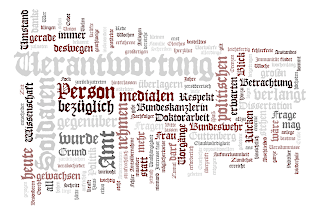 This is what zu Guttenberg should have said:

This is probably what zu Guttenberg meant:

This is what zu Guttenberg said today:


This is probably what zu Guttenberg meant:

Dismissed!
"Weggetreten!" - the military command soldiers are relieved to hear was the title of the special news report after the 8pm evening news. Mr. zu Guttenberg called a press conference for 11.15 and declared that he was stepping down - not because of the pressure, but because the focus was on his person and he wants to avoid hurting the army in the process (video - text).
Merkel regrets his decision, the CSU is shocked (they now have to dig up someone willing to take on the job), the scientists are relieved, his supporters are busy liking the Facebook page. One commenter on the GuttenPlagWiki page estimates that there are about 30 likes a second happening. The GuttenPlagWiki is collecting all the press references to them.
Germany's journalists are all disappointed, they've been collecting material like crazy for the past 2 weeks, they now have to figure out how to use it. I am enjoying a lot of questions about ghostwriters and plagiarism detection systems.
An interesting phenomenon is the polls asking if he did the right thing. Telephone polls are running 1:9 saying he should not have quit. Some online polls are 1:1 undecided. Other online polls are 9:1 saying it was about time. This demonstrates quite nicely the bias inherit in many of the methods used for polling. Young people often don't have a landline anymore, so calling on the phone will skip many young people. Not all Internet users will take polls, either. So all we know is that we don't really know what the German populace really thinks.
Maybe now we can have some peace and quiet. I am currently looking at how the plagiarism detection systems rate the thesis. It's a lot of work, but we are making some interesting discoveries on how the systems deal with this kind of thesis. I will report on the results when we have them!
I want to thank all my new readers (and especially the commenters!) and I hope you keep your RSS readers tuned to this station. I am certain that this is not the last bit of plagiarism or scientific misconduct.
Guttenberg steps down
I have to get to a meeting, but we have to have this news in English right now:
At 11.15 this morning zu Guttenberg held a brief press conference and announce that he is resigning immediately as Minister of Defense.
Yesterday a basket full of signatures from scientists and doctoral students in Germany was taken to the Chancellor's office protesting the opinion that it was just a few footnotes that were missing. Honesty is our currency in science!
We are very relieved that he has taken this step. We also hope that this is a wakeup call for the scientific community to look more closely into how we mentor students.
Saturday, February 26, 2011
An Open Letter to the Chancellor
German scientists and doctoral students are signing an open letter to the German Chancellor by the droves. There are some 7000 signatures as of Feb. 26, 2011.
I've had a request for an English translation, how can I resist that, with so many people now reading this blog and commenting? Since I didn't go to the demonstration in Berlin this afternoon, I will offer this translation
I've had a request for an English translation, how can I resist that, with so many people now reading this blog and commenting? Since I didn't go to the demonstration in Berlin this afternoon, I will offer this translation
Dear Chancellor Merkel,
as doctoral students we have been following the current discussion about the plagiarism accusations against the Minister of Defense, Mr. Karl-Theodor zu Guttenberg. We are shocked and do not understand what is happening. We have the impression that you are trying everything in your power to keep a minister in your cabinet who still insists that he did not knowingly deceive in his doctoral thesis, despite massive evidence to the contrary.
With this course of action, the German government and the members of parliament from the coalition [of CDU, CSU and FDP] damage not only themselves, but much more.
Zu Guttenberg has had to distance himself a number of times from statements he has made about his dissertation. The Internet community has with an unparalleled effort managed to demonstrate numerous incidents of clear plagiarism in Mr. zu Guttenberg's dissertation. The evidence can be openly seen and checked by anyone. It should not surprise anyone that experts in plagiarism are united in the opinion that this is not just a few "embarassing errors". This is massive, systematic deception.Zu Guttenberg copied large portions of his dissertation from various sources - apparently with great ambition - and did not name those sources in order to obtain a doctoral title that he used for, among other things, election advertising. The University of Bayreuth did not address this issue of deception [when revoking the doctorate].
In the face of the extent and amount of plagiarism found, it should be as clear to you as it is to us that at the end of an exact investigation by the university, only one result will be possible with respect to the intent to deceive on the part of the minister. This cannot be done unknowingly.
Calling the deception a deception has nothing to do with the minister belonging to a particular political party. We would also demand that politicians from opposing parties step down, if they had given their word of honor that the work was only their own, except for sources as noted, and had plagiarized in the same manner.
On February 23, 2011 Mr. zu Guttenberg stated that he only wants to be judged by his performance as Minister of Defense. He alluded to a phrase you had used when you said that you did not hire him as a research assistant.
This makes a mockery of all the research assistants and doctoral students who honestly endeavor to contribute to the advancement of science. This makes it sound as if obtaining a doctoral title by fraud is just a trivial offense and that the academic word of honor is meaningless in everyday life.
When following the rules of good scientific practice it is not just a question of footnotes, trivialities that can safely be neglected in the face of the larger political problems of the day. This is the foundation of our work and our trustworthiness. We strive in our own work, according to the best of our knowledge and conscience, to reach this high goal at all times. When we fail, we run the risk - and rightly so - of being expelled from the university.Most of us teach younger students. It is often our job to teach them the basics of good scientific practice. We insist that the students be exact at all times, correctly quoting and clearly noting all help that was used. We don't do this because we are fanatics about footnotes or because we live in an ivory tower and know nothing about real life. It is our intention to pass on the understanding that scientific progress - and with it progress for society as a whole - is only possible when we can depend on the honesty of the scientific community.
When our students violate these precepts, we grade their efforts as unsatisfactory. On repeated violation, as a rule we try to expel them. Those who have been expelled are denied access to numerous career opportunities - and rightly so - even for jobs that are much less in need of personal integrity than the office of the Minister of Defense.
We may be old-fashioned and are spouting outdated conservative values when we are of the opinion that values such as veracity and a sense of responsibility should also be valid outside of the scientific community. Mr zu Guttenberg seemed to be of this same opinion until very recently.
Research contributes a valuable service to the development of society. Honest and innovative science is the foundation of the prosperity of our country. When it is no longer an important value to protect ideas in our society, then we have gambled away our future. We don't expect thankfulness for our scientific work, but we expect respect, we expect that our work be taken seriously. By handling the case of zu Guttenberg as a trifle, Germany's position in world science, its credibility as the "Land of Ideas", suffers.
Maybe you consider our contributions to society as being negligible. In that case, we kindly request that in the future you refrain from referring to Germany as the "Republic of Education and Culture", as you often proclaim.
Sincerely,
The Undersigned [at the time of translation]
3242 doctoral students
1817 persons with doctorates
2579 other supporters
Around 300 persons gather downtown under the motto "summa cum fraude" and walked peacefully to the Ministry of Defense, where they put shoes on the top of the spikes on the railing - a symbolic gesture of disrespect used during recent protests in Northern African and Middle Eastern countries.
Update 1: Here are some pics from the demo from the Berlin newspaper Tagesspiegel.
Update 2: Polished up a bit, thanks to missionmi!
Update 3: If you want to sign the German version, please click here or on the link "open letter" above!
Update 4: Wow - the open letter made it to the evening news (Tagesschau)
Update 5: Now you can sign the letter in English as well! There is also a possibility for non-academics to sign. Today alone over 12.000 signatories were counted!
Wednesday, February 23, 2011
Dr. Strg+X
Well, this has to be a record. I believe this is the shortest university decision process in the last 400 years or so. Last Tuesday evening the story broke, just over a week later the university commission for good scientific work at the University of Bayreuth reached a decision.
They are rescinding his doctorate.
They didn't go into details, and most important, didn't decide if he plagiarized on purpose. He says he didn't, the documentation found on the GuttenPlagWiki screams a different story. Since he has announced that he wanted to withdraw his doctorate anyway, he won't contest it, so they don't have to do the normal detailed analysis.
Spiegel notes that he has sacrificed that title for his career as minister. And that his popularity has risen through all this. Some are calling him the German Sarah Palin.
And I am a bit worried about the tide of anti-intellectualism washing over Germany at the moment. People who have been irritated for years at people with doctorates pulling rank and being high and mighty about having this special title. It's been demonstrated to be a sham, all this "summa cum laude" stuff, so just ignore them. The Green party was being very snide during the public grillings today, constantly calling him "Herr Dr." - since the doctorate had not yet been rescinded, they could not be rebuked by the president.
This whole affair has done a great disservice to the German scientific community. We have been tried in the court of the mass media and found lacking. We must get serious about the topic of plagiarism and scientific misconduct NOW. No more playing around, being gentle to colleagues caught red-handed. No more doctoral titles easily purchased. No more made-up data. The hard part will be convincing the ministers of education that funding universities on the basis of quantitative measures is nonsense.
I suppose I should thank Mr. von und zu Guttenberg for getting my topic of plagiarism into every newspaper and every Stammtisch. Can we get back to work now, please?
The Story Continues...
It's really great to see that the discussion is continuing although zu Guttenberg has said that he will give up his doctorate and has written a letter to this effect to the University of Bayreuth. Some of the major points:
I just listened to him explain himself to the German parliament in a grilling. He's sorry, he had a lot to do, he didn't do it on purpose, it has nothing to do with his job as commander-in-chief, and he's setting a fine example, encouraging people to work hard and be even more careful than normal when doing research.
Now, what do I do with the two plagiarists I caught this week reading through papers?
- How can the two army universities currently deal with plagiarism, if their commander-in-chief is a plagiarist?
- Why do people in business need doctorates on their doors?
- What is the state of science in Germany if simple plagiarisms like this are not found? Does that mean that many more are floating around?
- People who worked hard for their doctorates are madder than hornets at this, as people keep asking them if they really did their own work or only plagiarized.
- People who like zu Guttenberg still insist that this is still just a commie plot to discredit Mr. Clean, even when faced with a mountain of evidence to the contrary.
- Why don't the universities mentor their doctoral students better?
- Why can't a software be written to sort of solve all our problems?
- Mr. Gadaffi, Jr.s doctorate from the London School of Economics seems to smell a bit like a plagarism
 |
| From the fine collection of Guttenberg Artwork at the GuttenPlag Wiki, by Freecopy |
Now, what do I do with the two plagiarists I caught this week reading through papers?
Monday, February 21, 2011
Guttenberg folds
He's given up.
The crowd-sourced project at GuttenPlagWiki published a summary (in German) of the most interesting bits of plagiarism found during these intensive days. It's fascinating - and very well done. They have worked hard to remain scientific about this, slapped down the gleeful punks (they get rid of their excess energy in the chat: "Mein von mir verfasste Plagiat ist keine Dissertation", my plagiarism written in my own hand is not a dissertation), and brought it to a sharp point. I spoke briefly - and anonymously - on the phone with the main author today. He is said to be a doctoral student, and I think he did a smashing job getting this organized and sorted out and written. And very nicely sourced.
Guttenberg announced this evening, just in time to squeeze into the evening news that he reread his thesis over the weekend and has decided to ask the university to rescind his dissertation. He will hand back the certificate, and asks forgiveness from his mentor. Oh, and he's staying Minister of Defense.
The university still needs to continue the proceedings, I feel. And I very strongly suggest that the University of Bayreuth take a deep, hard look at how the mentor doctoral students and how they go about determining grades.
On a side note, it was fascinating to watch a grass-roots movement with some simple, sharp tools (a wiki, a chat, a forum, a scanner) deconstructing the text, determining the sources for most of the pages and even visualizing how the thesis was written: copy & paste, change a word here and there, move some stuff around, translate a bit mechanically. This is the stuff that can radically change science: working in the open as opposed to a closed lab; fending off opponents as you work; and collaborating instead of working alone.
Thanks, Wikia, for providing the storage space!
Subscribe to:
Posts (Atom)


 Posts


