Showing posts with label guest comment. Show all posts

Tuesday, March 1, 2016

Fake Academic Degrees in Russia

This is a guest post by one of the members of the Russian plagiarism documentation group Dissernet. 


Fake Academic Degrees in Russia 

By Andrei Rostovtsev  
dissernet@gmail.com

The practice of awarding fake academic degrees to politicians, businessmen, doctors in clinics, professors in universities, and teachers in schools, that is, to all those who wish to use their new academic titles to step onto a faster career route, is widely accepted in Russia. The academic titles are awarded throughout the country. This business is based on the production of falsified dissertations. In early 2013 a group of five scientists and journalists established a social network called “Dissernet”. The Dissernet is a volunteer-effort free association aimed at making fraud and trickery in the awarding of academic titles transparent and well-known to the public. By 2016, Dissernet activists have identified more than 5000 plagiarized and falsified dissertations. In falsified dissertations not only is the text copied, but also the numerical data in it are assigned to a different year or region (in economics, law, and sociology), or to a different disease and treatment (in medicine), see discussion below. Over 1000 cases of such dissertations are documented on the website of the Dissernet (www.dissernet.org). Statistical data collected by the Dissernet yield a number of conclusions discussed below.

First of all, there is an important difference between the ways scientific writings are plagiarized in Russia and in the Western counties. In the West, the plagiarism is often associated with an intentional incorporation of other people’s texts or ideas in one’s own scientific research. That is probably why the ‘western style’ can involve many intricate small-scale mosaic plagiarisms intentionally placed in the original text. Yet in Russia, most often Dissernet deals with authors who have never done research and might have never even seen their dissertation texts at all. Such ‘dissertations’ are usually nothing else but a mere compilation of other people’s texts glued one paragraph after another in a haphazard way, something Weber-Wulff calls “shake & paste” [1].

In extreme cases the new text is just an older dissertation with a title page changed to reflect the new candidate. Sometimes the new candidate changes the subject of his or her ‘research’ too—usually by contextually substituting some terms throughout the whole text. For example, one notorious ‘scholar’ transformed a dissertation about the confectionary industry into a dissertation about the beef-and-dairy industry by substituting ‘dark chocolate’ with ‘homegrown beef,’ ‘white chocolate’ with ‘imported beef,’ and ‘nut chocolate’ with ‘bone-in beef ’ (see http://www.dissernet.org/expertise/igoshin.htm and http://cook.livejournal.com/202638.html, in Russian). In the meantime, all the data, tables, pictures, and spelling remained unchanged. Sometimes such authors also ‘update’ the dating of the statistics they refer to, thus making their ‘research’ seem to have been done more recently.

Detection of thousands of fraudulent dissertations by the Dissernet is mainly the result of a unique technology used. In Russia, along with the dissertation a so-called avtoreferat must be made publically available before the Ph.D. defense. The avtoreferat consists of a shortened dissertation content (usually 20–30 pages) and the main research results. Importantly, the texts of the avtoreferats are indexed by public search engines (such as Google or Yandex). The dissertation itself is not usually indexed, however. But if the dissertation contains large fragments of plagiarized text, as described above, its avtoreferat would also have text coinciding with earlier works. The specific Dissernet software is able to pick up the avtoreferats one by one and takes advantage of the search engines indices to look for textual coincidences within the whole publicly available corpus of Russian digitized texts, including texts of other avtoreferats. This program runs 24 hours a day and 7 days a week. Thus a few hundred thousand dissertations have been automatically checked. Furthermore, Dissernet takes advantage of the common practice of a chain-like fraudulent dissertation production. As soon as a rampant plagiarism is detected in one dissertation, it is very likely to be detected as well in other dissertations defended by the same dissertation council or with the same supervisor. This happens because the producers of fake dissertations in Russia work in a conveyor-belt mode using very limited sets of scientific texts as sources. By focusing on practically totally plagiarized texts, the Dissernet deals only with a small tip of scientific fraud in Russia. But even so, in problematic fields such as economics and law, about 3 % of dissertations contain large-scale plagiarism. In pedagogy this fraction is a bit higher, but still below 6 %.

Such large-scale dissertation fraud in Russia is a result of corruption that has paralyzed the whole system of awarding academic degrees: from dissertation councils established by the leading universities, where the PhDs are awarded, through the Higher Attestation Commission—the agency which coordinates and validates the awarding of academic degrees—and finally, what is also very important, to editorial boards of scientific journals, where scientific papers of the prospective doctoral candidates have to be published prior the defense. It is obvious that if no real research is done, then no relevant scientific papers could be published by such research. Clear affiliations of Russian scientific journals with the fake dissertation industry run by universities (more exactly, certain dissertation councils) have also been traced by the Dissernet. Those three cornerstones (dissertation councils, the Higher Attestation Commission, and journal editorial boards) are the necessary working parts of the mechanism running the conveyor belts of the academic fraud in Russia. Very often the same persons serve in these three cornerstone bodies at the same time.
Figure 1. Statistics on false dissertations broken down by scientific fields. (Dissernet data)
Figure 1 shows statistics of fraudulent candidate (Ph.D.) degrees awarded in different scientific fields based on the present Dissernet data (n=5215). As one can see, the most problematic areas are economics, pedagogy, and law. These same areas are the most problematic ones in the everyday (non-academic) life of Russians as well. In my view, this correlation is not accidental. The academic community naturally erects a barrier in the way of fake sciences and mythifications, which could otherwise define a climate for the life of whole society. In the areas, where the academic community is strong enough to resist the fraudulent practice of awarding fake academic degrees, the entire non-academic society is not driven by the false ideas. In addition, according to SCOPUS, the proportion of fake dissertations in each scientific field is inversely proportional to Russia’s international input in these disciplines [2].


Figure 2. Geographic location of the major universities producing fake dissertations.
Relative contributions into the total productivity for Moscow
and St.-Petersburg are given in percentages.
Figure 2 presents the geographic locations of universities that award the fake degrees according the present Dissernet statistics. Obviously, Moscow and Saint Petersburg play the most important role as they are among the largest cities. Other cities and towns fall behind. The scale of falsifications in the Caucasus region is relatively large but on the whole, their share in national statistics isn’t that high. This means the phenomenon of scientific fraud in Russia is not a marginal one. It is not localized somewhere on the outskirts of the country. Today it plays a role of an institution that is well integrated into the contemporary Russian state. Why do we qualify this phenomenon as institutional rather than a subject to free market?

Several recent laws and decrees protect owners of falsified academic degrees. The most important one (see http://www.rg.ru/2013/10/01/stepen-site-dok.html and http://www.saveras.ru/archives/6450) makes it impossible to strip a person of an academic degree if its defense took place before 2011. The authorities are quite reluctant to revoke the fake academic degrees, even if the defense has happened after 2011. The reactions from those accused of plagiarism by Dissernet varies from ignoring it, through calling it nonsense and accusations that it is politically motivated, to accusing Dissernet members of unprofessionalism and arguing that only appropriate dissertation councils have the right to assess the quality of dissertations (E. Denisova-Schmidt, personal communication). This point of view is broadly supported by state-owned mass media. Still, as of today, the Dissernet has managed to convince dissertation councils to revoke about one hundred fake academic degrees.

Last but not least, Dissernet investigations are relevant not only for an assessment of the Russian fraudulent academic world. Most importantly, the Dissernet provides a unique view on the deterioration of some institution’s reputations in Russia. In order to illustrate this point, several reference groups may be considered: members of the Russian Academy of Science (RAS), directors of Moscow’s primary and secondary schools, chancellors of Russian universities, regional governors, and members of the State Duma. Members of each group are selected if they have been awarded an academic degree during the last 15 years. Dissernet did not detect any falsified dissertation by the RAS members. Of 141 dissertations defended by directors of Moscow’s primary and secondary schools, 23 satisfied the Dissernet criteria for largely plagiarized texts. This amounts to 16 %—a rate which is more than three times higher than the probability of finding large-scale plagiarism in a random pedagogical dissertation.

Figure 3. Breakdown of fake dissertations by occupation: a reputation crisis.
This implies a silent mechanism at work selecting and supporting those who are prone to falsifications. The next group is chancellors of Russian universities, which has shown an even higher fraction of 21 %. Of that, one third of such universities are in Moscow. The proportion of politicians representing regional governors and members of the State Duma is even higher, reaching 41 % for the latter. In short, Dissernet performs a sort of a litmus test, identifying those dissertations prone to fraud and trickery, depending on the circumstances, and demonstrates the reputation crisis in Russia. This is illustrated in Figure 3. Why are the authorities, which are charged with larger responsibilities, subject to this stronger negative selection? This question will have to be answered by sociologists rather than Dissernet.

Despite aggressive state politics directed at the Dissernet, this public initiative has gained a good reputation and respect in Russian society in general, as evidenced by several awards and the fact that the name itself has become a meme.

[1] Weber-Wulff, D. (2014). False Feathers: A Perspective on Academic Plagiarism. Heidelberg, Berlin: Springer. 
[2] Rostovtsev, A. (2015). Some Observations on the Subject of Dissertation Fraud in Russia. HERB: Higher Education in Russia and Beyond, 3(5), 17–18. Available at https://herb.hse.ru/data/2015/09/22/1075563638/HERB_05_view.pdf

Saturday, January 4, 2014

Guest Post: Plagiarism has been left unpunished

This guest post is from Kayhan Kantarlı, a retired professor of physics from the University of Ege in Turkey. He published a first version of the article on his blog on December 10. I edited the article somewhat and am publishing this version here with his permission, as I do not read Turkish and am unable to verify the sources. -- dww


PLAGIARISM HAS BEEN LEFT UNPUNISHED
FROM NOW ON SCIENTIFIC FRAUD IN UNIVERSITIES IS FREE!
 By Prof. Dr. Kayhan KANTARLI
Retired Professor of Physics, University of Ege
e-mail: kayhankantarli@gmail.com
Obedience, on the part of scientists, to universal scientific ethics is a must; plagiarism/scientific fraud is a shameful act. In a country where scientific fraud is not punished and/or covered up, one cannot talk about modernity and the scientific world of this country has no respectful place in the eyes of the global scientific community. In modern countries, the punitive sanction protecting the scientific world from plagiarists is nullifying the degree (e.g. M.Sc. or Ph.D, etc.) and removing him/her from the university. Although most of the plagiarisms that are uncovered are unfortunately covered up –, our country, Turkey, does also apply this sanction.
                       
In accordance with the Disciplinary Regulations of the Members of Staff in conformity with the act of Higher Education Council (Turkish – YÖK), “to declare that the scientific paper or whole or partial work of somebody else without giving reference to it” is plagiarism, in other words is a fraud and the sanction is “removing him/her from the university”. This definition also has an international acceptance.
After Turkish Higher Education Council has adopted a principle with which the evaluation of scientific papers is being done not by the quality of the papers, but rather the number of papers published by a member of staff, it cannot be denied that the number of papers as well as the amount of fraudulent research has increased in Turkey. 
The present situation is such that plagiarism is so widespread and profuse that this situation has been the major problem of our universities. In response to this problem, in the year 1998 an article is added to the 11th item of Disciplinary Regulations of the Members of Staff defining that plagiarism is a shameful act deserving a sanction of removing from the university. But, this burdensome sanction, instead of creating a deterrent effect, has been ineffective due to the YOK’s policy not to implement it with a scientific understanding and impartiality. Particularly plagiarism and other fraudulent research of proponents of YÖK have been protected from sanction, therefore the 11th item is ineffective and the wound is still bleeding.  
While the situation rests in this critical position, the decision reached in September 2012 by the Plenary Session of Administrative Law (Divisions of Council of States) relieves plagiarism completely from sanction and this is the first time that public opinion has become acquainted with this decision.  In that decision it is stated that the sanction put forward in the Disciplinary Regulations of the Members of Staff as “to remove the member of staff from the university because of committing plagiarism is not covered in either the YÖK act No. 2547 nor in the public employee act No. 657”, therefore is unlawful (*).  
By the decision of Divisions of Council of States, the sanction “removing from the university” proposed for shameful act of plagiarism for scientists has been annulled. This annulment means that unless an act clearly states that plagiarism is a crime, it can be lawfully committed. 
Because the Disciplinary Regulations of the Members of Staff had been put into effect by the YÖK act No: 2547, the lawfulness of the decision for sanction reached by Divisions of Council of States is disputable.
In this case, what YÖK was expected to do was to take initiative in order to get rid of the unlawfulness and ask the Ministry of Education and the Parliament to enact a law. Nevertheless, YÖK has not taken an initiative to get rid of the legal loophole ever since September 2012. Circular order on the decision reached by Divisions of Council of States sent to the universities by YÖK also sent to faculties by the rectorship (*) appearing in the website of Istanbul University confirms this unlawful situation.    
The sanction “removing a member of staff from university” proposed in the Disciplinary Regulations of the Members of Staff has been annulled by a judicial act. In this respect, YÖK Presidency committed a crime by not filling the legal loophole; it is a breach of duty. In the circular order (*) sent to the universities by YÖK on September 2012, it is required that “in the inquiries claiming the presence of plagiarism, proceeding should be carried out in accordance with the relevant law”. But negligence in this respect ended in not punishing those found to have committed plagiarism since September 2012. YÖK’s circular order means that any member of staff in any university going through an inquiry about well-established plagiarism can keep working at the university as if nothing had happened.            
On the other hand, in accordance with the decision reached by the Divisions of Council of States, all the sanctions of “removing a member of staff from the university” due to plagiarism given in the past are “annulled by law”.
This situation gives an opportunity to those who had been removed from the university due to plagiarism, to return to their job in the universities and claim compensation of reparations, salaries and all sorts. Such an implementing causes a monetary damage of government and worse than that, means rewarding a shameful act of plagiarism. This is a scandal could never be seen in a modern country. 
I invite relevant authorities to take measures against the president of YÖK who committed the breach of duty by letting the collapse of scientific ethic in universities.  
We should not let this legal loophole created by the Divisions of Council of States causing plagiarism be unpunished forever. Legislative bodies should immediately take the necessary legal arrangements and bring an end to this situation, which only encourages those with a tendency to commit scientific fraud.  

(*)  The sources are the Divisions of Council of States and circular orders by YÖK and the rectorship of the Istanbul University. One can reach the source from the address given below

 http://personel.istanbul.edu.tr/wp-content/uploads/2013/11/%C3%9Cniversite-%C3%96%C4%9Fretim-Mesle%C4%9Finden-%C3%87%C4%B1karma.pdf

Edited to fix numbers issue

Wednesday, December 25, 2013

Guest post: Citation-based Plagiarism Detection

I hope to be able to post some of my backlog over the holiday season. This post is by Bela Gipp. I was an external examiner for the doctoral dissertation on Citation-based Plagiarism Detection that he defended in September at the University of Magdeburg. A student project at my university helped Bela develop an interface for his system.
– Debora Weber-Wulff


Can citation patterns help detect heavily disguised plagiarism in academic documents?


by Bela Gipp


A while back, Retraction Watch, a blog on scientific integrity, reported on five plagiarism cases discovered in Neuroscience Letters. Three cases translated Chinese originals into English, while another translated a French text into English. None of the cases acknowledged they were translations.
Translated plagiarism remains one of the most difficult forms of academic misconduct to detect. Since few researchers actively follow the literature in multiple languages, peer review is unlikely to recognize translated plagiarism. Software is largely useless in helping to identify translated plagiarism, because today’s plagiarism detection systems rely on a minimum amount of text similarity to spark suspicion, yet translations typically contain very low or no textual overlap. When documents use different alphabets, e.g. Chinese, Korean, or Russian characters compared to Latin characters, available detection systems stand no chance.
A new approach for plagiarism detection, termed Citation-based Plagiarism Detection (CbPD) goes beyond literal text similarity to detect potential plagiarism. The citation-based approach examines the in‑text placement of academic citations to form a language and text independent “fingerprint” of semantic similarity. The practicability of this citation-based approach was initially demonstrated in an analysis of the translated plagiarism in the prominent plagiarism case of K.-T. zu Guttenberg. Recently, a group of researchers in cooperation with students from the HTW-Berlin developed the first citation-based plagiarism detection prototype, “CitePlag”.
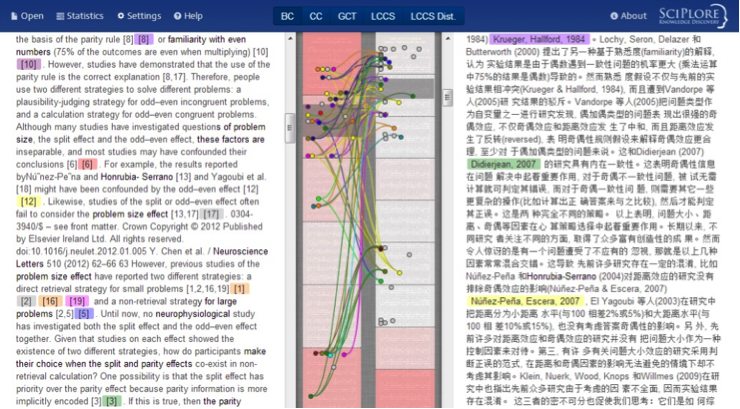
In the image below, CitePlag visualizes one of the five articles that were retracted from Neuroscience Letters. No textual similarity remains between the two publications, since the plagiarism (left) is a translation into English of the Chinese original (right). The citation-based approach, however, identifies and connects matching citations in a central scrollable column for human inspection. Examine this example for yourself in CitePlag. For more information on the prototype and the algorithms it implements, refer to this publication.
A medical article in Indian Journal of Urology was recently retracted after the CbPD approach identified a notably high citation pattern overlap with a journal article published in another journal two years prior. The citation-based similarities, as well as the text, which the retracted article shared with its source can be examined using the prototype here.


Sunday, November 3, 2013

Guest commentary: Plagiarism Probabilities

[I have offered guest commentary privileges to anyone interested in posting longer pieces than the comments section will accept. This is the first such comment. -- dww ]
Plagiarism Probabilities
by Gerhard Hindemith
In response to the Copy, Shake, & Paste article  "Automatic plagiarism accusation?" on the documentation of plagiarism in the dissertation of Frank-Walter Steinmeier I would like to make the following comments:
There is an intermediate version of the computer-generated report available online: http://web.archive.org/web/20131012050153/http://www.profnet.de/dokumente/2013/8048r.pdf. The latest update, including most Vroniplag Wiki finds, can be found here: http://www.profnet.de/dokumente/2013/8048r.pdf
Surely the author of the report would claim that most commentators criticizing it did not understand it correctly. The report claims for each fragment a plagiarism probability (Einzelplagiatswahrscheinlichkeit), and if that is low, say 1%, the claim of the report is not that the documented fragment constitutes in fact plagiarism, but rather that it will be plagiarism only in one of 100 comparable cases. Having that in mind, one should disregard those "low probability fragments" for most purposes (and it is not quite clear, why they are included in a report aimed for the public in the first place). The system then goes on and calculates an overall plagiarism probability (Gesamtplagiatswahrscheinlichkeit), which supposedly (none of this is explained in the report unfortunately) then is the probability that the entire thesis should be considered plagiarism. With this understanding, the report makes sort of sense conceptually -- but that doesn't really help much. I think the report should never have been published, even if these clarifications are understood. Here are my reasons:
  1. If the outcome of this report really is only a plagiarism probability below 100% (it was around 60% in the beginning), publishing it seems quite unethical, because at that point there was a 2/5 chance that the dissertation was perfectly OK (if we believe the system ... see further down, whether that is a good idea).
     
  2. The professor made confusing claims with respect to how these probabilities should be interpreted. Here for instance: http://www.n24.de/n24/Nachrichten/Politik/d/3599146/-wir-finden-noch-mehr-bei-frank-walter-steinmeier-.html he claims that in Steinmeier's thesis 400 passages are not OK, that in fact Steinmeier has forgotten the quotation marks in 400 instances. ("Und bei Herrn Steinmeier kam eben heraus, dass 400 Textstellen nicht in Ordnung waren. Konkret heißt das: Er hat bei 400 Stellen die Anführungszeichen vergessen."). Now, this is much more than the claim that the system has found certain (low) probabilities for plagiarism. It seems that the professor is swinging back and forth between quite bold claims (400 instances of forgotten quotation marks) that attract attention and cautious remarks about the correct interpretation of the findings (the system only finds "plagiarism indicators", often with low probability attached, not certain plagiarism), when challenged with concrete examples.
     
  3. As I said, conceptually I can imagine that the probability set-up could make sense, but in practice the details matter a lot. Not only for the technically minded insider, but also for the reader trying to make sense of such a report and the so prominently placed probabilities. The following questions would need to be explained in order to ensure one can interpret the findings of the report:

    3a) What is the definition of "plagiarism" for a single fragment? Is every small citation mistake considered plagiarism, or only more severe cases of verbatim copied text of a certain length? Is self-plagiarism included? One needs to know this to understand what a plagiarism probability of say 20% actually means.

    3b) Equally, one would need to know what the definition of "plagiarism" for the entire dissertation would be. This could be as severe as "at least one citation error in the entire thesis" or as forgiving as "the plagiarism is so severe that even a medical dissertation in Germany would be rescinded". Without this definition, the overall probability figure is meaningless.

    3c) Important for the interpretation of the probabilities would also be an explanation, how these probabilities are conditional on the choice of potentially plagiarized sources, whether they are independent of text length and with what suitable confidence intervals comes their estimation.
     
  4. I have very strong doubts that the probability calculator has been developed on a methodologically sound basis. But maybe I am wrong. In order to check this, the following questions would have to be answered:

    4a) How has the probability calculator on fragment basis been built? Given that surely an automatic system cannot be taught to detect plagiarism directly, it would pick up certain factors that point towards plagiarism (like identical text and the length of it, lack of quotation marks, lack of reference, etc.) and estimate the plagiarism probability on the basis of those factors. The question is then: on the basis of what pool of text fragments with known plagiarism status has the tool been calibrated? Surely this pool would have to be fairly diverse, covering different plagiarism types, citation styles, and subject areas, and hence would have to be quite large, to achieve a certain statistical validity of the calibration results? How has been assured that this pool includes a representative proportion of fragments that are not considered plagiarism? What is the discriminatory power of the resulting probability calculator?

    4b) According to which logic have the fragment level plagiarism probabilities been combined to form the overall plagiarism probability? How has the overall probability been calibrated, on the basis of what pool of dissertations with known plagiarism status? How has the fragment-to-fragment correlation been accounted for that surely is induced by a consistent writing style throughout the thesis? (e.g. if in the whole thesis italics mark quotations (or a different text size/color for that matter), this might not be picked up by the system and the plagiarism probability on fragment level would be consistently over-estimated.) What is the discriminatory power of the overall probability calculator?

    4c) In the case of the Schavan thesis, a similar report has been generated, apparently following the same methodology: see here: http://www.profnet.de/dokumente/2013/11357profnet.pdf. This report gives an overall plagiarism probability of 100%. How can an automatic system reach absolute certainty, particularly for a dissertation where the passages of verbatim copied text are very limited? This 100% value makes me suspect that the system has in fact never been calibrated, and the probabilities given have no empirical basis, but are rather heuristic constructs that somewhat point in the right direction? If this was the case, one would have to ask, why such probabilities have been calculated in the first place, with apparent high precision up to a single percentage point?
I leave it at that. If there are reasonable answers to all these questions, I would be amazed, and the probability calculator would constitute a very interesting diagnosis tool and certainly an advance scientifically (the author of the report should then definitely publish his research). But given the complexities of plagiarism detection (as opposed to text parallel detection), I suspect the discriminatory power of an empirically built tool would be disappointingly low and its calibration extremely involved and costly. I don't believe the report about Steinmeier's thesis is generated by such a tool because the provided documentation (close to none) gives me no reason to believe it was but rather several indications that it most likely was not.